All of Us!

All of Us!
Finally! All together with enough time to spare (??) to capture a picture of all six of us in the same spot, same time. Now this is a precious photo! I tried to get one last year for our Christmas card and didn't succeed. So when I had the chance I threw out the lasso and rounded everyone up (at my niece's graduation party) to grab a couple snapshots. My oldest son, Casey, and his girlfriend Nika are on the left; and my youngest son, Brady, and his girlfriend Jenne on the right; that leaves Bob and I in the center. (Bob is the one who doesn't look very happy about having his picture taken!!)

Sunday, August 19, 2012

Texas Brownies -- Legal or Illegal?

Now that I am back from getting my oil changed and a little coffee time at the Viking CafĂ©, I think it is time for some baking. Bob has been complaining for the last two days that he has no chocolate in the house, so I’m thinking Texas Brownies with a little coffee. That will definitely quell his craving for chocolate, but as for the coffee, I’m not talking a cup of coffee to go with the brownies. I’m talking coffee in my brownies. 


Did you know that coffee enhances the flavor of chocolate? It does! If you really want to magnify the chocolate flavor in something, there is a simple trick you can use with almost any recipe. The secret ingredient is coffee (or espresso if you have that on hand). A few tablespoons of very dark coffee along with the liquids in your recipe will amplify the chocolate flavor without giving it a coffee taste. If your recipe does not call for coffee, just be sure to subtract the amount of coffee or espresso being used from the overall liquids in the recipe. But if you don't want to mess with proportions in the recipe, you can also dissolve one or two tablespoons of espresso powder into the liquids to get the same effect.  In this case, there is no second guessing on the proportions because it is part of the recipe. 

Now have you ever wondered why you crave coffee in the morning or a chocolate candy bar makes you feel good when your mood is melancholy? A 2010 study from Ohio University enlightens us on why certain foods affect your moods.  Different foods stimulate different regions of the brain, releasing chemicals like dopamine and serotonin that promote well-being. However, the radiance created by chocolate and coffee isn't just caused by caffeine, but also by a rush of dopamine that triggers the brain's pleasure receptors. Chocolate also releases a form of opiate that causes that relaxed feeling, along with a small amount of a substance kindred to marijuana. With all that pleasure jammed into a chocolate bar, it's a miracle the chocolate isn’t regulated by the federal government!

It is reported that the downside of the brain is that it always wants too much of what is bad for the body, like sugar, to articulate with other neurons and is apparently particularly ravenous for it in the morning.

With this recipe, you can help those greedy cravings.

 
First, let's get out our butter. You can use cold butter, because it has to be melted. While I drop two sticks in a pan, I'm heating up 1 cup of water in the microwave for about 60 seconds. Because of this recipe, I always have instant coffee on hand. Just a small jar to keep on hand will do you, unless, of course, you're an instant coffee drinker, then you should have some on hand. If not, brew some coffee or make these brownies in the morning while you are having your "cup of joe." 


Two teaspoons into the hot water and stir, then dump this into the melting butter and add 1/4 cup unsweetened cocoa (I will confess I use a heaping 1/4 cup).


In the meantime, I have placed two cups of flour and two cups of sugar into my mixing bowl. If not sifting my dry ingredients, I always try to aerate them. In this case, I am just taking my whisk beaters and whisking through the flour and sugar to place some air into them. Simple, fast and easy to do. With the butter melted and the rest of the ingredients coming to a boil, I take the pan off the burner and pour it into the flour/sugar mixture. Turning on the beaters, I then add my baking soda and vanilla. 


Next I prepare some buttermilk. I don’t keep buttermilk on hand, but if you do, it is 1/2 cup. For my substitute, I simply pour just shy of a 1/2 cup of milk into a measuring cup and then add about 2 T. of cider vinegar. (When  I was questioned once about whether you should use white vinegar or cider vinegar, my philosophy is if you are baking or cooking I always use cider vinegar. If cleaning, I use white.) Anyway, this creates the same effect as buttermilk. I dump that into the mixing bowl and now my batter has sufficiently cooled so that I can add in the eggs. Remember, never add eggs to a hot mixture or they will turn to scrambled eggs and, sorry, we are not serving them this morning! 

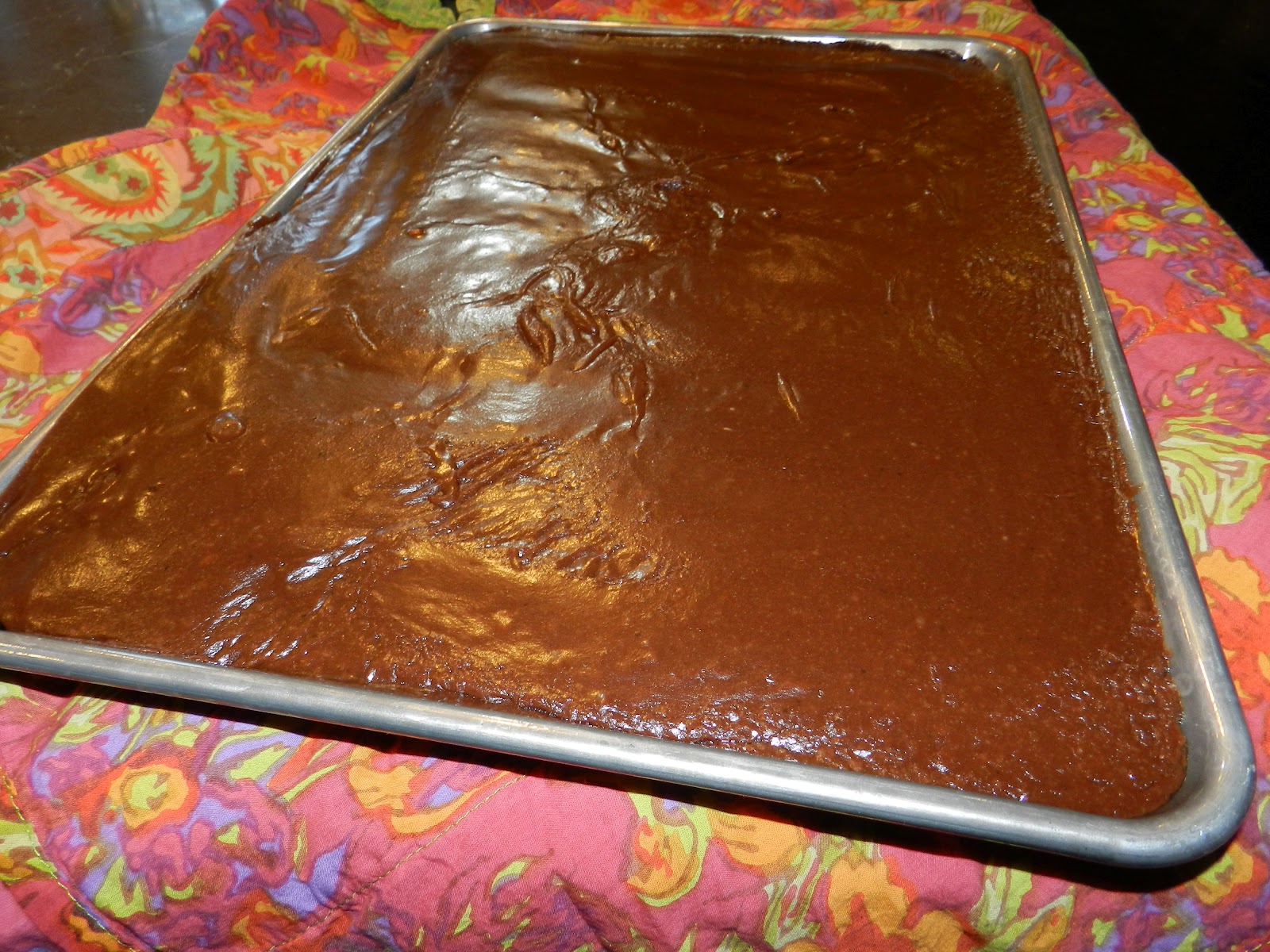
Mix on high speed until combined and then pour it into a greased jelly roll pan (17x11). Bake at 400 for 20 minutes or until they test done in the center. I generally set my timer for around 16 minutes to make sure they don’t burn around the edges. 


Now, while the brownies are baking, it's time to prepare the frosting. This will be poured over the brownies as soon as you take them out of the oven so no need to cool the brownies first.

I use the same pot that I used for the first stage of the brownies – no need to dirty another pan if one does not have to. In it goes 1 stick of butter, 1/4 cup of cocoa and 2 (heaping) tablespoons of cocoa. Make sure to stir this often and once this comes to a boil, turn on low. Add in 3-1/2 cups of powdered sugar, whisking it as you go and then 1 tsp. vanilla. The frosting will show small lumps of powdered sugar but that is okay as it adds to the character of this delight. As soon as the brownies are done, immediately pour the hot frosting over the brownies and smooth out. It will set quickly.


There you go, simple, easy, and, once you take a bite or two or three, yes, I’m thinking – possibly illegal.  Hey, what can I say ... the brain wants what the brain wants!

 
*********************************

TEXAS BROWNIES

2 cups flour
2 cups sugar
1 cup (2 sticks) butter
1 cup strong brewed coffee
1/4 cup dark, unsweetened cocoa
1/2 cup buttermilk
2 eggs
1 tsp. baking soda
1 tsp. vanilla

Frosting1/2 cup (1 stick) butter
2 T. dark, unsweetened cocoa
1/4 cup milk
3-1/2 cups unsifted powdered sugar
1 tsp. vanilla

Directions
(1) In a large mixing bowl, combine the flour and sugar.
(2) In a heavy saucepan, combine butter, coffee and cocoa. Stir and heat to boiling.
(3) Pour boiling mixture over the flour and sugar in a mixing bowl. Add the buttermilk, baking soda, vanilla and eggs.
(4) Mix well on high speed.
(5) Pour into a greased 17x11 jelly roll pan.
(6) Bake at 400 degrees F for 20 minutes or until the brownies test done in the center.
(7) While brownies bake, prepare the frosting. In a saucepan, combine the butter, cocoa and milk. Heat to boiling, stirring.
(8) Mix in the powdered sugar and vanilla until the frosting is smooth.
(9) Pour warm frosting over brownies as soon as you take them out of the oven. Cool.

Enjoy!

Wednesday, August 1, 2012

Life Is...Succulent (so are these Baby Back Ribs!!)

[Side note:  I told you I had some posts waiting to be published, so here is one from Memorial Day -- the day our big walnut tree in the backyard blew over from the storm that came through late in the afternoon.  Enjoy!]

Speaking of downed tree ...

Walnut Tree Blown Over and Pulled Up By The Roots and All!
****

Life is what you make it.  This year on Monday, Memorial Day, I decided to make it ... succulent.  I am talking Slow Roasted Baby Back Ribs with a Bourbon Glaze.  My mouth starts to water every time I think about it.

This is not a recipe that you can throw together and eat an hour later.  We are talking a few hours here.  It is, however, easy to make, but patience has to be your virtue and I guarantee you the pay off is well worth it.
Dry Rub on the Ribs
At 7:00 a.m. I got the meat out of the refrigerator -- two whole slabs of pork baby back ribs -- rinsed them off, patted them dry and laid them each out on on a jelly roll pan that I had placed a long strip of aluminum foil on (long enough to have about two inches left on each end.  Next I began to put together the dry rub.  This is simple and easy to do.  Five minutes max and you are generously sprinkling it over one side, patting the dry rub in and turning each over to do the same on the other side.  Once the dry rub is on, I covered the top of each with aluminum foil and placed them in the refrigerator (on their pans) to rest and soak in the dry rub.
Putting on the braising liquid
Since I had lots of work to do outside, making the time go by in between pampering the ribs, was no problem.  

I pre-heated the oven to 250 degrees and started mixing up the braising liquid.  An hour later, I took the ribs out of the refrigerator and placed it on the counter.  I unfolded the top of the foil to expose the long slab of ribs.  Next, I took the braising liquid and poured half over each slab, carefully lifting up the ribs from the foil while doing it so that some went underneath the ribs, too.  Once this was done, I prudently folded up the foil to make packets to keep the liquid in and placed them in the oven to slow-roast for 2-1/2 hours.

Coming out of the oven after a slow roast and ready for the grill
I went back outside and tended to my gardens and planted some pots with annuals.  Time flew by and before I knew it, it was just about time to take the ribs out of the oven.  I went inside and washed up and started mixing up my bourbon glaze.  Once completed and my 2-1/2 hours of slow roast time were up, I took the ribs out of the oven and placed them on another pan.  I decided to cut each slab into two sections which was just easier to handle when placing on the grill, etc.  They already smelled delicious.  Now they needed a little extra special touch.
Putting them on the grill
Off to the grill we went.  I fired up my gas grill, lighting my front and back burners on a low to medium heat.  Next I took my brush and started swabbing the glaze on one side (a spoon can be used just as easily).  Once I had one side done on all, I placed each on the center part of the grill rack, glazed side down, and begin swabbing the top side.  I closed the grill and let them grill for a good 7-8 minutes, then turned them over to let the other side grill.
5-Cheese Creamy Garlic Baby Red Potatoes
In the meantime, I set the table, took out of the oven my 5-cheese creamy garlic baby red potatoes that had been baking for a couple hours to let them rest, grabbed my cut up fruit and a tortellini salad leftover from Sunday, some dinner rolls and everything was ready to go by the time I went out to take the ribs off the grill.  They had just the right grilled touch to them and I couldn't wait to get to it.  By the time I took them inside and let them rest for about 5 minutes, we were ready to plunge in.
Ready to come off the grill and into our mouths!!!
And believe me, these ribs did not disappoint.  They had just a nice tinge of of sweetness and spiciness.  My hubby does not go for spicy, and these are not.  Now, if you wanted to, you could definitely switch this a little bit and go for more of a barbecued flavor instead of the bourbon glaze.  Either way, these tender ribs are ready to be eaten however you want to serve them up.

I have included the recipe below, which is a combination of a few different recipes I found, all put together to my likes.  Enjoy!! 


Slow Roasted Baby Back Ribs with a Bourbon Glaze
2 whole slabs pork baby back ribs
DRY RUB:
8 T light brown sugar
3 T kosher salt
1 T chili powder
1/2 tsp ground black pepper
1 tsp chili powder
1 tsp Caribbean Jerk Seasoning (if you don’t have–use 1 extra tsp chili powder)
1/2 tsp Old Bay Seasoning
1/2 tsp ground thyme
1/2 tsp onion powder

BRAISING LIQUID:
1 cup white wine
2 T white wine vinegar
2 T Worcestershire sauce
1 T honey
2 cloves garlic, chopped
BOURBON GLAZE:
8 T honey
1/4 cup bourbon
2 tsp white wine vinegar
1 T Dijon mustard
1-1/2 T molasses
1-1/2 tsp soy sauce
1-1/2 tsp Worcestershire sauce
1 tsp chili powder
1/4 tsp salt
1/4 teaspoon ground black pepper

DIRECTIONS:
Preheat oven to 250 degrees.
In a bowl, combine all dry ingredients and mix well. Place each slab of baby back ribs on a piece of aluminum foil. Sprinkle each side generously with the dry rub. Pat the dry rub into the meat. Refrigerate the ribs for a minimum of 1 hour. In a microwavable container, combine all ingredients for the braising liquid. Microwave on high for 1 minute. 

Place the ribs on a baking sheet. Open one end of the foil on each slab and pour half of the braising liquid into each foil packet. Tilt the baking sheet in order to equally distribute the braising liquid. Fold up the aluminum foil around the ribs. Braise the ribs in the oven for 2 1/2 hours. Take out of oven after 2-1/2 hours and place on grill. Brush with bourbon glaze on both sides. Turn once to grill each side for total of 10-15 minutes. 

Monday, July 30, 2012

Sunday Dinner: Tipsy Chicken Breasts and Triple Cheese Bread


When I was growing up, Sunday dinner (lunch) was a big thing.  At home on my childhood farm, Sundays usually meant we may have visiting relatives from the city (Madison).  So we were always prepared, just in case, which meant a bigger than usual meal.  Sometimes, those old habits never die.

It is Sunday and I have to figure out what is on the menu for today.  After contemplating this early morning quagmire, I decided against beef and am going with chicken breasts.  Now to format my entire menu and decide what to do with the chicken breasts.   

At last year’s 1st Annual O’Connor Girls Luncheon, one of the breads we were treated to was a cheddar bread which came from Bake UR Own.  Since that time, I have been in search of a recipe similar to that or something I can make into my own to serve the same purpose.  This recipe popped up and now is the time to try it.  What I like to do with recipes which I find or maybe after tasting a particular food I adored, is to either take the recipe (or create a recipe) and create something similar and “make it my own” where I can twist and turn it a little, add this or that, more to my liking.  I have had a recipe for a couple weeks for Triple Cheese Bread which I wanted to try and thought this would be the most opportune time to jump in and see if it is what I am searching for.  
The ingredients are added to the bread machine
I pulled out the bread recipe and my bread maker and set off to get that started.  Since this isn’t exactly a one-hour prep-and-ready-to-eat type thing, it needs to be started early in order to be ready for lunch.  I have included the recipe below and shared some preparation pictures.  


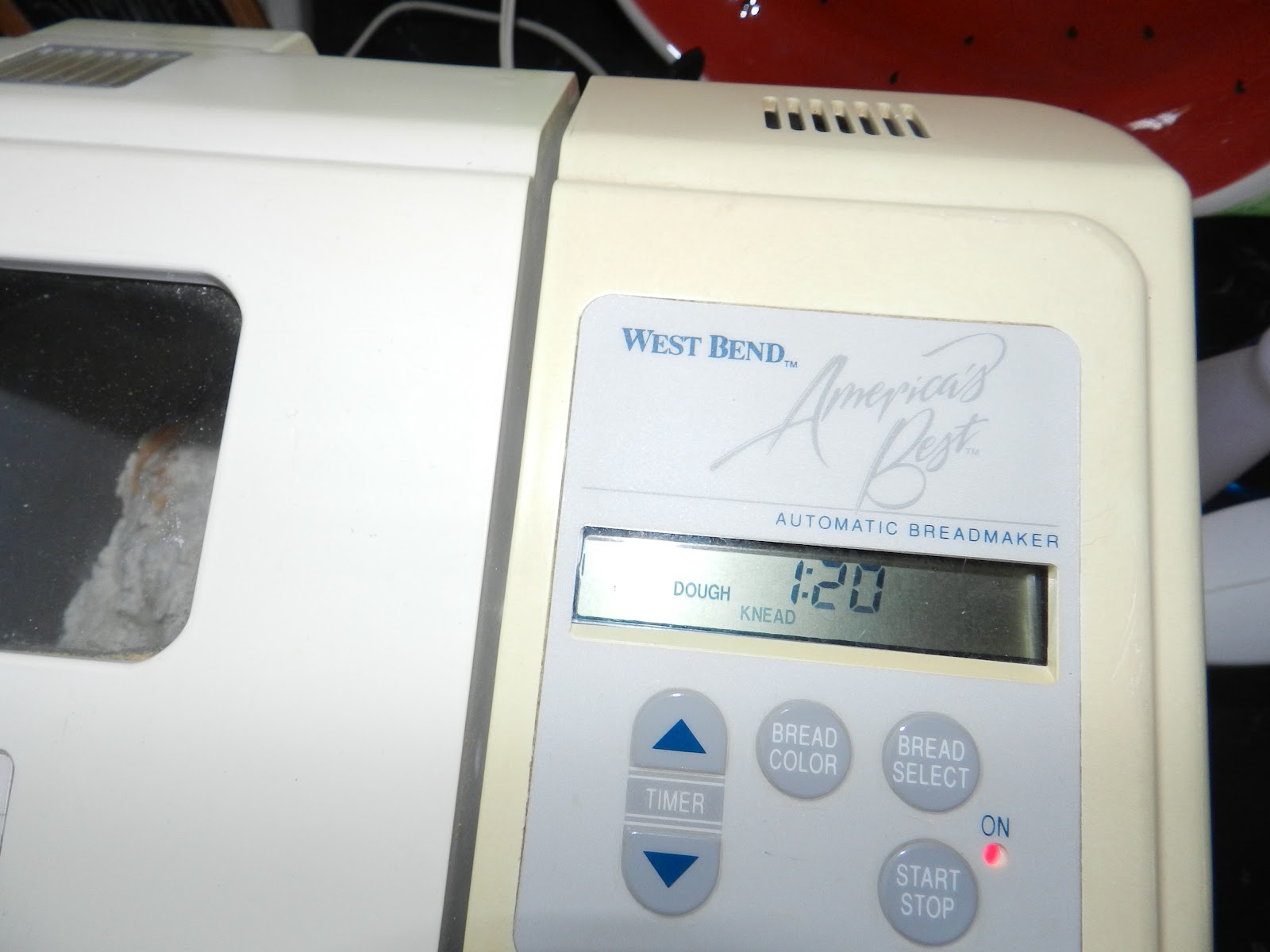
The bread maker setting put to "Dough" and now we just let it do its job (for 1 hour and 20 minutes)!
We're out of the bread maker and onto a floured (glass) cutting board to start the hand-kneading process


When the bread maker had completed its initial mixing and kneading, I pulled the dough out and plopped it onto a floured cutting board.  The kneading by hand starts now. Time to roll up the sleeves!  Eight to ten minutes of hand-kneading may seem like a long time, but it is nothing compared to if we did it all by hand.  It is easy to wile away those small minutes once you get into a rhythm.

The dough is put in a bowl to rise some more
When I'm done kneading, into a greased bowl it goes and then gets covered with a warm, wet towel so it can raise some more.  Once doubled in size, I can take it out. 


Here we go to a parchment-lined baking sheet to raise some more before going into the oven

Setting the bowl of dough next to the stove/oven gives the rising process a little extra help.  As it is just about doubled in size, I am able to take it out of the bowl, deflate the mound, and cut it into quarters, then each quarter into thirds and fold them over into balls.  Placed on a parchment-lined baking sheet, it is then covered with a greased piece of wax paper and off to sit next to the stove/oven again to raise some more. 

Triple Cheese Bread (Rolls)
And here we have the final product! See the flecks of cheddar cheese!  It is ohhhhh, so good, but, I confess, not quite there for what I am searching for.  Oh, well, I guess, I'll have to keep searching and practicing!  (I enjoy practicing!)

Now, let's hop back to the rest of the Sunday's menu.  We are doing mashed potatoes, steamed veggies (broccoli, carrots and cauliflower which will be seasoned with some garlic powder and parsley) for a touch of color to our plate and Chicken Breasts in a Garlic White Wine Cream Sauce. 

The chicken breasts are fairly simple and (just for you) I have included that recipe below.  I've peeled the potatoes, put the veggies in the steamer basket/pot and both are placed on the stove to start their road to yumminess.  This also helps create a little more heat to give a little extra boost for the rolls in rising.  Let's now get started on those chicken breasts. 

Wine, Worcestershire Sauce and Butter -- a few of the chicken ingredients
I've placed four chicken breasts into a frying pan with a little extra virgin olive oil and seasoned them.  Once they have started to brown on both sides, I add in some butter and the diced onions and minced garlic. I have to confess (again!!!??!!) that I also added some Rotisserie Chicken seasoning to the chicken breasts.  (I can't help myself -- it is my new-found friend in the kitchen!)

Browning the chicken breasts and sauteing the garlic and onions
When they have browned slightly, I add the wine, let it reduce a little (or as I like to consider it, when I feel the chicky has enjoyed enough of its mid-morning cocktail hour), it is time to add the cream.  Because I want to keep this warm and yet cook them a little more, no more cook top; it is off to a 325 degrees oven but not before I top each off with some shredded Romano cheese.  (What!!! More cheese??!! Come on! I was born and raised on a dairy farm, and since my hubby and I still dairy farm -- did you expect anything less? haha!) 

Chicken Breasts Drunk with White Wine are Now Ready to Head to the Oven
As everything else comes together, I've tucked the rolls into a bread basket and finished the gravy.  I just have to take the chicken out of the oven, mash the potatoes, and pull the veggies out of the steamer.

Everything is all set to go . . .
The only thing left to do is plate it up and enjoy another Sunday dinner (lunch)!

Did you forget? I'm the butter gal; Bob gets the gravy.
I hope you get a chance to try these recipes and enjoy them as much as I did (and will some more in the very near future)!

******************************

Here are the recipes for the chicken and the rolls:

Chicken in Garlic White Wine Cream Sauce

Ingredients
4 boneless skinless chicken breasts
2 tablespoons olive oil
1/2 cup onions, chopped
3 minced garlic cloves
5 -6 fresh mushrooms, sliced (I didn't have any mushrooms on hand so didn't use them)
1/4 cup butter
1/4 cup white wine
1 dash Worcestershire sauce
1 pint cream ( heavy or light)
salt and pepper
1 teaspoon basil
1 teaspoon parsley

Directions
*Lightly brown both sides of chicken in olive oil.
*Add onion, garlic, mushrooms, and butter and saute about 4-5 minutes until onions start to become translucent.
*Add wine and Worcestershire sauce and cook an additional 2 minutes.
*Lower heat and add cream, salt, pepper, basil, and parsley.
*Too high of heat will cause the cream to curdle.
*Simmer on low 20-25 minutes until done.

Triple Cheese Bread

Ingredients
3/4 cup water
2 tsps. Yeast
3 cups flour
2 T. sugar
1-1/2 tsps. salt
2 T. butter, soft
½ cup shredded cheddar cheese
½ cup cottage cheese (or if no cottage cheese on hand, use sour cream)
1/4 cup grated Parmesan cheese

Directions
Dissolve yeast in 1/4 cup of the lukewarm water. Add the remaining ingredients and mix and knead by hand, in your mixer, or in your bread machine on the dough cycle to make a soft dough.

Turn onto a floured board and knead for 8-10 minutes, until smooth and elastic. Place in a greased bowl, cover and let rise until doubled. About 45 minutes.

Deflate the dough, form it into a 9" log and place it in a greased 9x5 loaf pan. Cover loosely with greased plastic and let rise until the bread domes an inch above the rim of the pan.

If making dinner rolls, divide the dough into 12 equal pieces and shape into rolls. Place the rolls on a lightly greased or parchment-lined baking sheet. Cover loosely with greased plastic and let rise until almost doubled, about 30 minutes or so.

Bake the risen dough in a preheated 350 F oven for 20-25 minutes for rolls; 30-35 minutes for a loaf.

Sunday, July 29, 2012

Tonight It Is Chicken Alfredo

[First off, I have to apologize, that I am breaking my own rule as far as posting something new before I finish my NY trip.  Obviously, I haven't finished the last of my posts regarding that, but here goes a new one off that subject.  I have a few sitting and waiting for me to post and I need to get on with them and finish up the The Big Apple trip when I can.  Hope you enjoy! The New Day Everyday Woman Has Returned to Her Roots!]

**********************************
What’s fun about coming home at night after a grueling day at the office and one of the first dilemmas you face is, what’s for supper? When you are the supper-maker, it falls on your shoulders to figure it out. A lot of the time when I am stumped, I will unfortunately ask my husband what he wants. I usually, I’m sorry, I always get the same answer – I don’t care. But he does. He will moan, make faces – much like a 6-year-old when told he has to eat his spinach before he can have some ice cream -- and then say "again?" Okay, well at least I made the first step in asking him. He will tell you he would eat pizza every night, but truly admittedly he won’t – unless it is Rocky Rococo’s.  Consequently, I’m left to the task of answering the age-old question.

Be that as it may, even though I am arm-loaded with a vast library full of cookbooks (I’m not kidding here either – I have more than 120 hardcover recipe books, plus many, many soft cover cookbooks, AND my own collection of large binders, sorted by food type, which contains probably 1,000+ recipes), I still have problems trying to get creative on any given night. I have tried the route of planning, cooking on the weekend and then pulling it out to serve like I had cooked all day long ala June Cleaver; but the pretty picture just isn’t that pretty in reality. My hubby is picky, although he will say he isn’t, and to be perfectly honest, sometimes I’m not in the mood for whatever is planned for that evening. So, instead I capitulate to my yearnings to decipher what it should be tonight. 

The other night, after some contemplation and not much time, it was Chicken Alfredo. Sometimes I will have some leftover chicken to use for this recipe, but it just so happened after a recent trip to the store, I had picked up a package of deli-roasted Oscar Mayer chicken breast pieces. This is one of the easiest ingredients to use for Chicken Alfredo. The rest is up to you on how you want serve it. Egg noodles seem to be a big staple in my house. My husband tends to like them better than fettuccine noodles, angel hair, etc.


I will confess to you now, unless I am forced to measure out pasta, when it comes to my recipes, they are usually measured by handfuls, or jar full. My pasta when bought is then opened and placed into containers for storage. And that is how I tend to know how much to put into any given recipe.

In this case, I put on a large pot of water, salted (hmmmm....good tablespoon), brought to a boil and then dumped in about 4 good handfuls of noodles. As that was cooking, I placed a small frying pan on the stove, turned to medium heat, added about a tablespoon of EVOO (extra virgin olive oil) and then placed the whole package of deli chicken pieces in to warm. Any larger pieces, I cut down to size. Next eventually turning the heat to medium low. After the noodles were cooked, I placed them in a colander to drain (do not rinse!). Using the same pot, I placed the butter and cream cheese to melt over medium low heat; then began adding the cream/milk and other ingredients. Once okay to taste, I placed the noodles in to coat and then added the chicken; placed in a serving bowl and then sprinkled with paprika.

One side note to this recipe – I sometimes use real garlic, taking cloves and mincing them and then sauteing in EVOO. In this case with lack of time, I use the garlic powder which is a big, big staple in my kitchen for fast recipes.

Total time spent for this meal – 30 minutes. Not bad for timing and until the end, I wasn’t slaving over the stove making this either. Below is my alfredo sauce recipe. Enjoy!

Alfredo Sauce
½ cup butter, melted
1 pkg (8 oz.) Cream cheese, room temp. (or put in a microwave for 1 minute)
2 cups half-and-half (or I used skim milk to reduce the fat)
½ cup grated Parmesan cheese 2 T. garlic powder (or 2 garlic cloves, minced, sauteed)
½ tsp. Black pepper
1 tsp. Perfect Pinch Rotisserie Chicken seasoning
salt to taste

Wednesday, June 27, 2012

The Big Apple: Day 4, Part 4, 2nd Portion of AMNH -- Ackley Hall of South African Mammals

We have left the reptile hall (not that I did or wanted to spend much time in there -- my least favorite creatures!) and are heading back to the Ackley Hall of South African Mammals.  While we are visiting this Hall, I thought it might be fun to give you some fun facts about some of the animals, not all, but a few. 

Large Elephant Display
One of the displays that I truly loved the most had to be this first set of pictures -- the elephants.  It was so neat how they had them displayed.  So proudly walking in line as if they were doing a migration journey.  As you walked around this huge display, you see the care and detail with which they took to capture the large mammals in action.  And so cute was the way the little one had his trunk wrapped around the larger's (I assume Momma) trunk.

Elephant Display
Since I loved this display so much, I thought I would share some fun facts about elephants.  As they are the largest living land animals on Earth, their gestation period is 22 months which is longest of any land animal. They typically live for 50-70 years.  A calf typically weighs 230 lbs. at birth. An adult normally weighs around 230 lbs; the largest male (every recorded) weighed in at 24,000 lbs. They are considered a symbol of wisdom in Asian cultures.  Elephants are famous for their memory and intelligence.

Their trunks are used for drinking as they suck water up into the trunk (approximately 15 quarts) and then blow it into their mouths.  They also use their trunks for social interactions such as greeting each other by entwining their trunks, like a handshake, caressing during courting and mom/child interactions, or in play-wrestling.  They will also use their trunks to defend themselves.  It is also relied upon for its highly developed sense of smell.  An elephants skin is inordinately thick (1 inch).  They can swim well, cannot trot, jump or gallop but have two gaits – a walk and a swifter walk comparable to running, of which is normally about 8 mph but have been reported to reach up to 25 mph. 
More Elephants

Living in a very structured social order, the males and females' social lives are different.  Females spend their time in family groups consisting of mothers, daughters, aunts and sisters, led by the eldest female, while males live a solitary life.  While the females interact with other families or clans, they remain enormously aware of which localized herds are related and which are not. 

Next up, the famously-decked-out-in-stripes zebra.  

Zebras are part of the African equids (horse family) species. Their stripes come in different patterns unique to each individual. They are generally social animals that live in small harems to large herds. The common plains zebra is about 50–52 inches at the shoulder with a body ranging from 6–8.5 feet long with a foot-and-a-half long tail.  With males slightly bigger than females, a zebra can weigh up to 770 pounds.
Zebra

Zebras have excellent eyesight. It is believed that they can see in color. Along with an acute sense of smell and taste, they have excellent hearing, and can turn their ears in almost any direction. Like horses, they sleep standing up, and only sleep when neighbors are around to warn them of predators.

Zebras communicate with each other with high pitched barks and whinnying. Grevy's zebras make mule-like brays. A zebra's ears signify its mood. When a zebra is in a calm, tense or friendly mood, its ears stand erect. When it is frightened, its ears are pushed forward. When angry, the ears are pulled backward. When surveying an area for predators, zebras will stand in an alert posture; with ears erect, head held high, and staring. When tense they will also snort. When a predator is spotted or sensed, a zebra will bark (or bray) loudly.

Have you ever heard of a koodoo?  The kudus, or koodoo, are two species of antelope: Lesser Koodoo and Greater Koodoo.  Here are some interesting facts about koodoos.  Male koodoos live a solitary life and can be found in bachelor groups, leaving only to mate.  As is always the case with males (haha!), dominance plays also plays a part in the lives.  It is not long-standing, but to display his sway, he will make himself look big by making his hair stand on end.  Also intriguing about the males is when they have a face-off, they will lock their horns in a competition to determine the stronger puller but sadly sometimes two competing males are unable to unlock their horns and, if unable to disengage, will die of starvation or dehydration. 
Koodoo

Pregnant females will leave the herd to give birth to a single offspring which she will leave lying hidden for four to five, coming back only to nurse. The calf will then start  having intermediate meetings with its mamma and at 3-4 months of age will be with its mother constantly. 

And the last little tidbit about koodoos; the koodoo horn, a musical instrument made from the horn of the kudoo antelope, is sometimes used as a shofar in Jewish ceremonies, mainly at Rosh HaShanah, to announce the beginning of holidays; or in Biblical times to signify the start of war.

Who can't be amused by these next amazing creatures! The giraffe, noted for its extremely long neck and legs stands at 16-20 feet tall with an average weight of 3,500 lbs. for males and 1,800 lbs. for females.  The males in this mammal species establish their social rankings through "necking", which are combat bouts where the neck is used as a weapon.  The dominant male is the one who gains mating access to females.

Giraffe
With its front legs slightly longer than its hind legs, a giraffe has only two gaits: walking and galloping.  While galloping, it can reach a speed up to 37 mph.  The long neck results from a disproportionate lengthening of the cervical vertebrae, not from the addition of more vertebrae which largely takes place after birth, as mom giraffes would have a taxing time giving birth to babies with the same neck proportions as adults.


Okapi
Now, the okapi, bears striped markings impressionistic of zebras, instead of its cousin, the giraffe.  Their striking horizontal white stripes on the front and back legs, are thought to possibly help young follow their mothers through the dense rain forest and may also serve as camouflage.  With their body shape similar to the giraffe, without the extremely long neck, okapis have very long (approximately 14 inches), flexible, blue tongues that they use to strip leaves from trees and with which it can also wash its eyelids and clean its ears (inside and out).  I guess they certainly don't need a Q-tip!  

Like the koodoo, the okapi males are also solitary animals coming together only to breed.  Not social animals, they prefer to live in large, secluded areas. To mark their territory, besides urine marking, the okapi has scent glands on each foot that produce a tar-like substance which allow them to communicate to others "no trespassing."


Gorilla
Gorilla time: Gorillas are considered to be the closest relative to humans besides chimpanzees.  On average, human genes differ only 1.6% from their corresponding gorilla genes.   Silverbacks (adult males) range in height from 5'5"– 5'9" and weigh in at approximately 310–440 lbs.  Females, on the other hand, are about half the size of a silverback averaging about 4'7" tall and 220 lbs.  Largely a herbivore, it is known that gorillas rarely drink water because they consume succulent, or water-retaining, plants, especially those with the morning dew on them.

Gorilla

Impala (below):  The impala, a medium-sized antelope, is thought to be plentiful with numbers of up to two million in Africa.  They are on average around 3 feet tall weighing about 88-188 lbs with females slightly smaller at around 66-110 lbs.  What I find unique about the impala is that while they stay near water in the dry season, they can go weeks without drinking if there is enough green coarse vegetation.  Leopards, cheetahs, lions and wild dogs prey on impala. 
Impala

Females and their young will form herds with numbers up to 200 individuals.  Similar to what I have seen on TV documentaries about lion prides, adult males will establish territories and while females will seek out territories with the best food resources, territorial males will round up any female herds that enter and chase away any bachelor males that are following; even sometimes chasing away recently weaned males.  Very domineering, a male impala will try to prevent any female from leaving his territory. However, if food resources are low, as during the dry season, territories will be abandoned as herds have to travel farther in search of food. 

Leopards, cheetahs, lions and wild dogs prey on the impala.  However, the impala has an incomparable defense technique wherein if they are frightened, the whole herd will start to leap about to confuse their predators.  To escape these predators, they can reach running speeds of up to 56 mph, can jump spans of more than 33 feet and 9 feet in height.  When escaping and to keep their herd together they perform a high kick of their hind legs, in which they release a scent from the glands in their heels.  What marvelous little idiosyncrasies Mother Nature has bestowed on some of her creative works!

Let's now travel from a smaller creature to a couple of more magnificent girth.
White Rhinoceros

The rhinoceros:  Did you know that there was such a thing as a white rhino and a black rhino?  Well, there is, so let's explore some of the differences; or are there any? The black rhino is smaller than the white rhino and has a pointed and prehensile upper lip, which it uses to grasp leaves and twigs when feeding, rightly adapted for browsing. The white rhinoceros has square lips used for eating grass, conversely adapted for grazing. The black rhinoceros can also be distinguished from the white rhinoceros by its size, smaller skull, and ears; and by the position of the head, which is held higher than the white rhinoceros, since the black rhinoceros is a browser and not a grazer.

White rhinos -- The white rhinoceros is the largest of the five species of rhinoceros and the world's largest land mammal after the three species of elephant.  The largest white rhino ever recorded weighed in at 9,900 lbs.! The color of the body ranges from yellowish brown to slate grey. Its only hair is the ear fringes and tail bristles. Its ears can move independently to pick up sounds but it depends most of all on smell. The olfactory passages which are responsible for smell are larger than their entire brain. The white rhinoceros has the widest set nostrils of any land based animal. White rhinos are divided into two sub-species: northern and southern.  The northern white rhino is virtually extinct with, as of 2011, only five known living on this entire planet.  In 2008, according to the International Union for Conservation of Nature (IUCN) in 2008, the southern white, on the other hand, was estimated to have 17,480 living in the wild, making them the most abundant subspecies of rhino in the world.

Okay,  so here is an icebreaker line to use at parties.  What is a herd of rhinos called?  A crash! White rhinoceroses live in crashes of up to 14 animals (usually mostly female). While most adult males are solitary, lower ranking, or subordinate, adult males will congregate, often in partnership with an adult female. I've spoke in this post about other dominant males, marking their territory and mating of different animals.  Another new, or somewhat used system, dominant rhino bulls also mark their territory with excrement and urine, but with a little twist.  They will lay their feces, or dung, well defined piles, sometimes as many 20 to 30 of piles to notify passing rhinoceroses that this is his territory. Another manner of marking their territory they employ is before urine spraying, the adult male will wipe his horns on bushes or the ground and scrape with his feet. The kicker -- they do this around 10 times an hour while patrolling their territory. The same ritual as urine marking except without spraying is also commonly used. The territorial male will scrape-mark every 98 feet or so around its territory boundary. Lower ranking males do not mark territory.

Black Rhinoceros
And what about the Black Rhinoceros?  They are differentiated by their narrow pointed mouth (in contrast to the white's wide mouth). Although it is referred to as the black rhino, it is actually more of a grey/brown/white color in appearance. 

There are four recognized subspecies of the black rhinoceros: South-central, South-western, East African, and West African.  However, in November 2011, the IUCN declared the Western Black Rhinoceros extinct.  The entire black rhinos species have been pushed to the brink of extinction by illegal poaching for their horn, and to a lesser extent by loss of habitat. A major market for rhino horn has historically been in the Arab nations to make ornately carved handles for ceremonial daggers called jambiyas. The horn is also used in traditional Chinese medicine, and is said by herbalists to be able to revive comatose patients, cure fevers, and aid male sexual stamina and fertility.


Colobuses
Black-and-white colobuses: This herbivorous species of monkey eats leaves, fruit, flowers, and twigs. As for their habitat, they can be found more in higher density logged forests than in other primary forests.

Colobuses live in territorial groups of approximately nine individuals, based upon a single male with a number of females and their offspring. Newborn colobuses are completely white. And you have heard that it takes a village to raise a child?  Well, in the colobuses' neighborhood allomothering appears to be going on.  This means that members of the troop other than the infant's biological mother care for it.  It seems are races are a lot closer in things than we realize.  One other thing, colobuses are important for seed dispersal in the forests which they accomplish through their sloppy eating habits as well as through their digestive system.


Ostrich
A "trip" to South Africa wouldn't be complete if we didn't touch on one more animal - the ostrich

The Ostrich is one of two species of large flightless birds native to Africa.  It has a distinctive appearance with its long neck and legs, and with the fastest land speed of any bird, it can run at maximum speeds of 43 mph.  Other “records” the ostrich has set are that it is the largest living species of bird and lays the largest egg of any living bird.  Their eyes are also said to be the largest of any land vertebrate.
Baby Ostriches and Ostrich Eggs

Mating amongst ostriches is a death-defying act, literally! Territorial males fight for a harem of two to seven females, and these fights, which usually last only minutes, are usually a fight to the death match as they can easily cause death through slamming their heads into opposing males.  If threatened, an ostrich can be considered a flight or fight creature.  It will either hide itself by lying flat against the ground or run away, or if cornered it will kick with its powerful legs.  An average ostrich will weigh around 140-290 lbs.  The males are mostly black with white primary feathers and a white tail.  Females and young males, on the other hand, are greyish-brown and white.

At maturity, males can reach from 5'11" to 9'2" in height, while females range from 5'7" to 6'7" and can reach an age of 40-45 years.  One other fact, contrary to popular belief, ostriches do not bury their heads in sand.  

This will now conclude our tour of some of the South African animals found in the Ackley Hall of South African Mammals. I hope you enjoyed learning a little about some of these mammals along the way.  

Our next stop will be in the fourth-floor halls which include the Hall of Vertebrate Origins, Hall of Saurischian Dinosaurs (recognized by their grasping hand, long mobile neck, and the downward/forward position of the pubis bone, they are forerunners of the modern bird), Hall of Ornithischian Dinosaurs (defined for a pubic bone that points toward the back), Hall of Primitive Mammals, and Hall of Advanced Mammals.  These you will find just as interesting, too.  So, if you are not yet bored, next up . . . dinosaurs.