All of Us!

All of Us!
Finally! All together with enough time to spare (??) to capture a picture of all six of us in the same spot, same time. Now this is a precious photo! I tried to get one last year for our Christmas card and didn't succeed. So when I had the chance I threw out the lasso and rounded everyone up (at my niece's graduation party) to grab a couple snapshots. My oldest son, Casey, and his girlfriend Nika are on the left; and my youngest son, Brady, and his girlfriend Jenne on the right; that leaves Bob and I in the center. (Bob is the one who doesn't look very happy about having his picture taken!!)

Monday, April 16, 2012

The Big Apple: Day 3, Part 6: Dinner (Irish Pub) and a Show (Comedy Cellar)


Okay, so here we are, we have now just left the Museum and we have to jump on the subway and quickly head back to the hotel to freshen up.  Also, I have to plug my camera in to recharge it.  While at the Museum my battery went dead and, of course, I forgot my backup battery at the hotel! DUH!!  Since we are back at our room just chilling for a few moments, I thought I should take a picture of me taking a pic of Nika and share that with you!  Haha!
Chilling in the Room

Getting back to the hotel at virtually the same time as Casey -- as this was Casey's first time at this hotel since Nika and I changed hotels early that morning when he left for work -- we got ready and then went next door to The Irish Pub for a great supper (while watching the Brewers game on TV).


The Irish Pub: Located right next door to our hotel, at 837 7th Avenue, The Irish Pub was established in 1939 and sits in the heart of Midtown Manhattan. They offer a wide variety of foods from the traditional Irish pub fare to classic American dishes and consider themselves a premier sports bar with many TVs and two 100" big screens.  At first, we were seated in the window which was a very narrow counter situated along the front or street-side of the bar.  It was packed in there at the time.  We told our hostess and waitress that we would love a table if one became available.  We had no more than sat down and she came back for us and seated us right where we could watch the big game -- well, big game to us at least, since it was Game 4 of the National League World series playoffs in which the Brewers were playing the Cardinals.  We were a little skeptical about cheering too loudly because New York had just lost out in their series and we didn't want to disturb any mourning that might be going on. With the series beginning on the 9th of October, the Brew Crew was in Game 4.

Casey and Nika at The Irish Pub

Game 4:  To refresh your memory of Game 4, here is a quick recap. Brewers starter Randy Wolf kept Milwaukee from falling into a 1–3 series deficit, by throwing seven innings, and striking out six batters. Bernie's Brew Crew then scored two runs to tie the game in the 4th inning, with Hairston hitting an RBI double to score Prince and then Betancourt followed up with a single to score Hairston.  We then scored another run in the 5th on a single by my hero Braun, and another run in the sixth, thanks to the Cards Thierot's error. Wolf, along with relievers Rodríguez and Axford finally shut the Cardinals down to even the series at two games apiece and guaranteeing that the series would end in Milwaukee. 

Me At the Irish Pub with my Imaginary Hubby
Back to the Irish Pub -- At right, I spoofed for the camera with my arm around my imaginary hubby -- yea, I suppose I could have brought a cardboard cutout of Bob and put him next to me, but it would have been extra baggage charges on the plane! hahaha! As for my meal, I had the fish and chips and it was so good. This was a indeed a legitimate Irish pub because all the wait staff had true Irish brogues, which was so fascinating to listen to.

After finishing our meal, we jumped on the subway for the second time (actually it would be the third) that day and off to Greenwich Village to the Comedy Cellar for a 10:00 p.m. comedy show that included 6 nationally known comics (who all live in the NY City area or burbs).

Casey and Momma
The New York City Subway is a rapid transit system owned by the City of New York and leased to the New York City Transit Authority, a subsidiary agency of the Metropolitan Transportation Authority and also known as MTA New York City Transit. It is one of the oldest and most extensive public transportation systems in the world, with 468 stations in operation (421, if stations connected by transfers are counted as single stations); consisting of 209 miles of routes, which translates into 656 miles of revenue track; and a total of 842 miles including non-revenue trackage. In 2011, the subway delivered over 1.640 billion rides, averaging over 5 million rides on weekdays, over three million on Saturdays, and over two million rides on Sundays.  

The New York City Subway is the seventh busiest rapid transit rail system in the world in annual ridership, after Tokyo's, Moscow's, Beijing's, Shanghai's, Seoul's, and Guangzhou's (f/k/a as Canton, China) rapid transit systems,  and the busiest in the Americas. It is one of the four systems in the United States, along with portions of the Chicago "L" system, PATH (Port Authority Trans-Hudson in New Jersey), and PATCO (Port Authority Transit Corporation), to offer service 24 hours a day, 365 days a year.
Crime rates have shown variations over time, with a drop starting in the 1990's and continuing through today.
All Three!
Photographing: After the 9/11 attacks in New York, the MTA was extremely wary of anyone taking photographs or recording video inside the system and proposed banning all photography and recording in a meeting around June 2004. However, due to strong response from both the public and from civil rights groups, the rule of conduct was dropped. In November 2004, the MTA again put this rule up for approval, but was again denied, though many police officers and transit workers still confront or harass people taking photographs or video. 

On April 3, 2009, the NYPD issued a directive to officers stating that it is now legal to take pictures within the subway system so long as it is not accompanied with suspicious activity.

Nika and me

Litter accumulation is a perennial problem in the subway system. In the 1970's and 1980's, dirty trains and platforms, as well as graffiti were a serious problem. The situation has improved since then, but the 2010 budget crisis has threatened to curtail trash removal from the subway system.  Just the other night, I heard on David Letterman that the Mayor had issued a proclamation banning eating on the subway (supposedly because of the draw of rodents).  Luckily,  I didn't see any huge rodents!

We had to consult the large subway maps to determine which lines and routes we were going to take to get out to Greenwich Village.  I am glad that Casey and Nika knew what they were doing, as I certainly didn't!

Getting on and off the subway was a lot easier than finding the Comedy Cellar itself.  We exited the subway and then tried to get our bearings on where we were walking.  We asked many people for directions but most didn't know where they were going either, so they were of little help -- probably all tourists like me!  Finally, we found someone who sent us in the right direction.

As we approached the Comedy Cellar we saw there were two lines out front.  I showed the person at the door our tickets and he told us to get into the line East of the establishment, which snaked around the corner, and we hopped in line.  The other line out front which went in the opposite direction was the line for those seeking a free pass into the show.  The CC distributes a limited number of free passes for shows taking place Sunday through Thursday.  If you are a local you just try to be the first ones there in hopes of snagging one.  If you are a tourist, I wouldn't recommend it, because  you run the chance the show is sold out and that everyone shows up for their tickets, and then you have wasted your time waiting in line.   People stand in long lines outside hoping to that people will not show up for their reservations. If there is room for these sold out events, then they allow those standing in line to come in. But with a capacity of only around 80-90 seats, they get sold out fast.

While we were standing in line, one of the comedians came out to entertain us while we were waiting.  He worked his way down the line doing a few jokes and magic tricks.  It helped pass the time, which wasn't really all that long as I think we were only in line less than a half hour.  Once the ticket holders to the earlier show emptied out, we worked our way in and found the seats we wanted and felt comfortable with.  First, they were close to the bathroom (that is, if you can call it a bathroom -- seriously, a one-seater shared by both sexes, that I have seen closets bigger than this!); second, we got end seats -- so we were not closed in; and third and most importantly, we were what we figured was out of reach for a comedian to pick on us!  You do not want to place yourself in prime real estate reach of a comedian because you know that out of the three of us, one of us would be the target at some point or another.

Next, let me give you a few tidbits of quick info on The Comedy Cellar. 

The Comedy Cellar - the lit-up area is where the comedians performed
The Comedy Cellar is a comedy club in Manhattan, where many top New York comedians perform. It was founded in 1982 by then standup comedian, and current television writer/producer Bill Grundfest. Located in the heart of Greenwich Village at 117 MacDougal Street, the upstairs portion is a restaurant called The Olive Tree Cafe, where many of the comedians hang out after performing. They share the same menu, kitchen, and staff.  Many people eat at the restaurant before attending a show.

The Comedy Cellar uses what is known as a "showcase format," as opposed to a headline format like most clubs. A show will consist of between five and seven comics performing sets of roughly 20 minutes each. 
People Filing in To Find Seats at The Comedy Cellar

Regular performers there include, and maybe you have seen or heard of some or all of these: Colin Quinn, Opie and Anthony co-host Jim Norton, Mitch Fatel, SNL star Darrell Hammond, Dave Attell, Louis C.K., Nick DiPaolo, Artie Lange, Dave Chapelle, and radio host Marc Maron. Also, some rising stars in comedy frequently perform, including Dov Davidoff, Robert Kelly, Sherrod Small, Keith Robinson, Gregg Rogell, and Ben Bailey.  Each week consists of two shows a night on Sunday through Thursday, three shows each Friday, and four shows on Saturday. The New York Post regularly rates the Cellar as the best comedy club in New York.  Musician John Mayer has also been known to dabble in a stand-up comedy performance there occasionally.  We found out that there is always the high probability of unannounced drop-ins by the likes of Dave Chapelle and Robin Williams. Much of Jerry Seinfeld's 2002 documentary Comedian was filmed at the club, and it also can be seen in a 2006 Pepsi commercial starring SNL star Jimmy Fallon. 


There is a two-purchase minimum per person.  But they offer a full bar with beer, mixed drinks and specialty cocktails, plus you could also order something from the upstairs menu which features burgers and wings or snack-type foods.

The Comedy Cellar


Continuing On About Our Cellar Experience:  I did mention before about the bathroom but the surroundings was that of a typical basement, with very low ceilings, dimly lit, and very, very tight quarters.  You could tell from the mixture of the crowd that the majority were probably college-age regulars, but there were those, like me, in the middle age range and also couples who appeared to be out for date night.  With the raucous atmosphere, you are taking your chances if you select this as your first-date night location, though. 

We couldn't take pictures during the show but, as you can see from the pictures above, this shows our seats which were great. We were in the first row right behind the front row which was fantastic because you could see the comedian great, but yet you were not in the immediate front row and getting picked on by the comedian!  A lot of politics and talk of Occupy Wall Street plus good old racial talk across the board. That is what I love about these comedy shows (if you have thin skin you shouldn't go) as this is a no-holds barred show. Every ethnic group and race gets beat up along the way but it is all in good fun.  If it is an African-American comedian, the Caucasian people are barbecued and served up on a platter, and vice-versa. The Middle-Eastern descent gentleman in the picture above (the only one who is facing the camera) definitely picked the wrong seat.  He was fodder for the comedians as they used him as their primary focus for Osama Bin Laden- and terrorist-type jokes.  And, this was when there was a lot going on in the Middle East in the way of territorial-boundary wars, etc. There was also a couple in the first row who were picked on pretty heavily, too.  Then there was the African-American woman with a pretty "heavy" chest, dressed a little too provocative, that also was a constant target.  See -- picking your seat really is something you need to pay close attention, too. 

The comedians we saw were: Andy Hendrickson - from HBO US Comedy Arts Festival, Xm/Sirius, Great American Comedy Festival; Moodi - from Comedy Central's "Tough Crowd", The Howard Stern Show, "Sopranos", Comedy Central; Lee Camp - from Showtime's "The Green Room", Comedy Central's "Fresh Debate", Contributor to "The Onion"; Sherrod Small - writer and actor on the new TBS show "Are We There Yet" which is produced by Ice Cube, "Red Eye" on Fox,  VH-1's "Best Week Ever", Comedy Central's "Tough Crowd", Showtime at the Apollo; and Justin Silver - from NBC "Law and Order" MTV New Year Comedy Special.  I was totally surprised with Justin Silver, as I have seen him regularly on Law and Order and did not realize he did stand-up comedy.  And then, of course, there was the host, Ardie Fuqua, who was just hilarious, too! It was a super night of comedy and I would definitely recommend this to anyone visiting New York City. 
 
After our 10:00 p.m. show ended, it was announced that since we had already gotten tickets and were there, we were being offered the opportunity to stay for the Midnight "Nasty" show.  Unfortunately, though, since it was already 11:45 p.m., it would have gotten too late for Casey since he had to go to work the next morning.  As those of us who weren't staying filed out, the patiently waiting line outside eagerly were ready to pounce on the empty seats.  You have to be a die-hard fan to wait in line like that, especially in this case since it was raining outside.  And here we were with no umbrellas with us either.  So we made a mad dash to head to the subway for some shelter from the rain. 


Once inside the subway, I found that there is always late night entertainment. 


Drummer in the subway

Music In the Subway: This guy, pictured above, was playing in the subway on our way home back to the hotel (probably around 1:00 a.m.). He was super and was also selling his CD's. He was what was labeled as a one-man E-percussionist.  Riding the subway, I found, can be very entertaining because it seemed there was always someone doing their musical thing along the way, whether it was this one-man band, a 3-person mariachi band that hopped on one car, or mimes that we encountered on one trek that pantomimed to the music.

With the rain still coming down, it was a good thing that our subway exit was just on the other side of our hotel building.  And, due to construction renovations to the facade of our hotel, there was scaffolding set up so we were able to walk underneath that to avoid the rain.  

Once inside our hotel room, Casey was hitting the pillow pretty fast.  I still had to download pictures to Facebook, as promised, so it was nearly 2:30 by the time I climbed under the covers.  

All in all, it was a great night for a dinner and a show! Day 3 of my New York Adventure finally closes.  It has unequivocally been another satisfying day in The Big Apple journey.  Time to turn in, so I say to you. . .Good Night All! Until tomorrow when we start Day 4.

Easter Family Gathering 2012 -- Yes, It Is All Cracked Up To What It Is Supposed To Be

Family holidays -- gotta love them!  I do, I really, really do!  I toil, bake, cook, clean, and run around like a chicken with its head cut off to host a holiday party (or any party for that matter), but I love, love, love doing them and wouldn't have it any other way. 
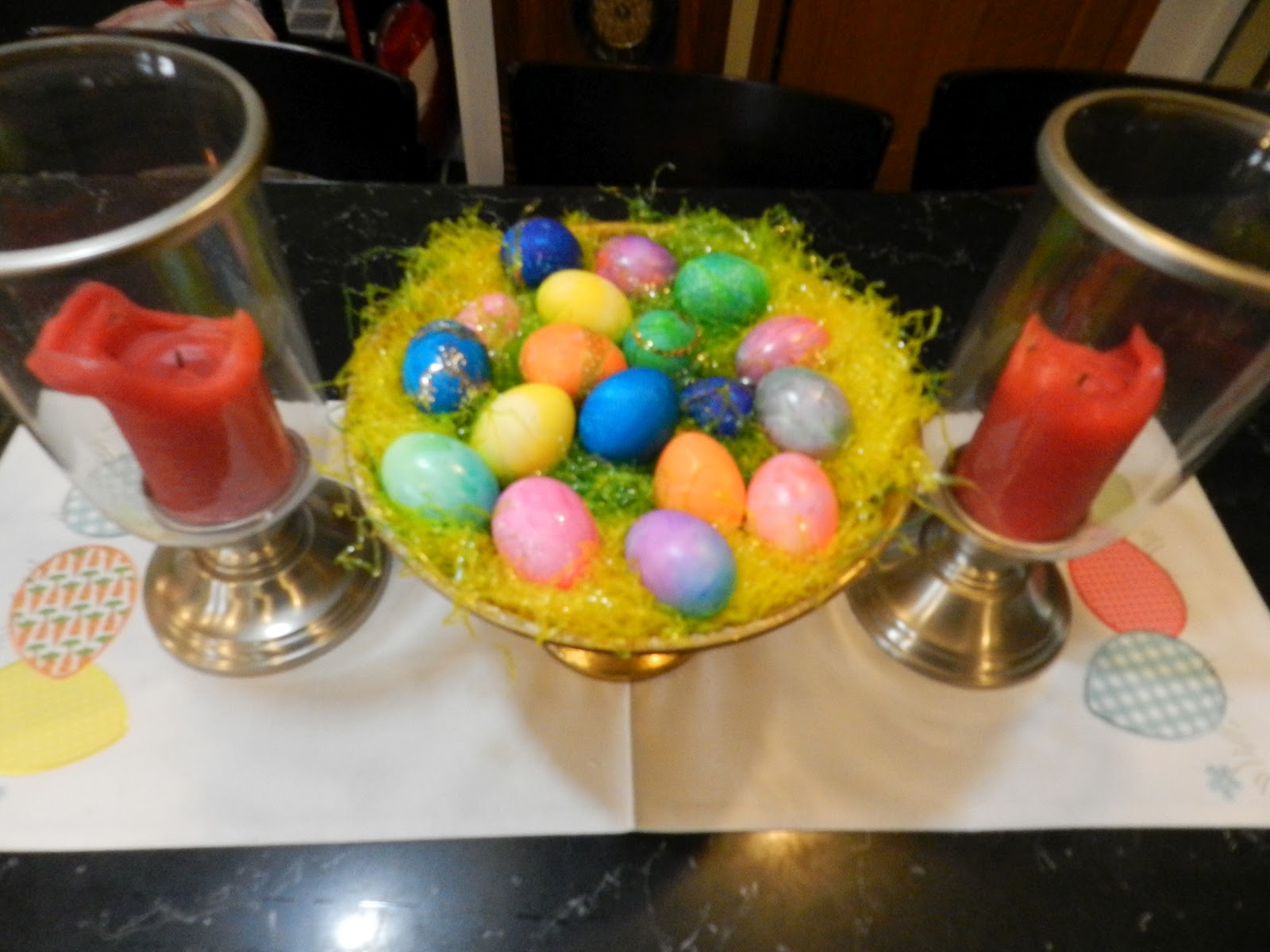
Centerpiece on my Kitchen Island
This year, as it is every year for Easter (for over 15 years), I hosted my side on Saturday, the day before Easter Sunday.  The holiday is made bigger when my sister, Suzi and her family from Minnesota come down, because (due to the distance, obviously) they don't get a chance to spend every holiday with us.  My niece and goddaughter, Kailey, is however, allergic to dogs.  We have Pongo in the house and Wolfie outside.  Due to her allergies, I always make sure besides vacuuming, that I shampoo all my carpets and wash all my throw rugs, to help possibly forgo any problems for her. 

Friday Prep Day: So, Friday brought shampooing carpets, besides the last minute tasks to getting ready.  The tables were set -- this year since another set of good china had been added to my collection, everyone was able to sit down to a total coordinated effort.  I know this sounds trivial, but to me I always am trying to coordinate all -- I'm very anal, if you haven't deduced that by now!  Black tablecloths with Easter table runners, my white china trimmed in gold, gold chargers for the adults, clear goblets, my good silver and gold flatware, and gold and black cloth napkins.  I took out my new and antique soup tureens to place on the tables, along with water pitchers, salt/pepper shakers and also grabbed water and milk pitchers from my collection that coordinated with the table settings.  Once all the napkins were placed on each place setting, I was satisfied with the arrangements, but knew that I had one last minute item that would go on each plate -- that I would wait until my youngest niece, Tabba, to arrive to have her help me with.  
What is left of my adult table setting after we got done eating.  See the new upholstered chairs!
I was up very, very early that morning, but still it seemed my day was slipping away rapidly.  I still had to make the desserts, salads, jello, cupcakes, wash floors and the throw rugs.  Plus, I had to get groceries.  My initial plan was to go early in the morning, but I decided I didn't want to break up my day, meaning that once I got up I wanted to hit the floor running and sweating and didn't want to have to clean up and change to go to the grocery store.  And the lawn needed to be mowed.  Luckily, after serving up a quick lunch to Bob, he agreed to go out and take a whack at the lawn, which has always been my job to do.  One less thing on my list. 
"Kids" Table - this was the centerpiece for their table which contained all the eggs for the hunt (alot missing now)!
Off to Get Groceries: Now, by the time I had gotten all but the desserts made, it was already 6:30.  I quickly cleaned up, changed and was on the road to Monroe by 7:00 p.m.  With two quick stops (okay, they weren't necessarily "quick" but quick as I could get when I am running around), I had the Durango loaded up with groceries and a few other Easter fill-in treats for the baskets.  My new find for this shopping trip was "Kinky Liqueur" which is a blend of distilled vodka, blood oranges, mango and passion fruit.  I glanced at my clock in the car as I turned on the ignition and couldn't believe it was already after 8:30.  My how time flies when you are having fun -- NOT!!  I just simply don't really enjoy grocery shopping anymore -- especially when I am in a rush (which 99.9% of the time when I grocery shop, I am).  

The kids' and Bob's Easter "Baskets"

Late Night: On the way home I called Bob and asked him to turn the oven on, as we were doing a rising crust oven pizza for supper.  I figured that could bake while he and I unloaded groceries.  With the groceries unloaded and a little supper under our belts, I shooed Bob off to bed so I could get down to some serious dessert-making.  My goals: devil's food Easter cupcakes, Better Than Sex dessert and a new find -- Strawberries and Cream Cheesecake.  The latter is the one I have never made before, which is always my personal challenge at each holiday; to find a new dessert and spring it on everyone.  Of course, I hadn't quite read through the whole recipe before and so once I sat down with it to read it in detail, I found it was going to be a little more time-consuming that originally planned.  With all the desserts complete, by 2:30 a.m., I pulled the finished cheesecake out of the oven.  Now I had to let it cool down before putting in the refrigerator.  I decided I needed to sit down on the recliner to maybe get in a quick snooze, so off to la la-land I went for one-half hour.  At 3:00 a.m, I awoke to find that the cheesecake was sufficiently cooled down, at least enough to put in the refrigerator.  Once done, off to bed I went, only to be awaken a little after 4:00 a.m. by a low.  

I dragged myself downstairs and had a quick snack of some milk and cheese and guided myself out of the low; sat down in the recliner for a half hour to read, rest and recovery, and by that time Bob was up.  Time for me to get up and rolling some more.  By 5:00 a.m., I was able to start functioning again, so it was time to put together the other foods that needed to be baked, cooked, etc., and to get some more last minute laundry done.  
My Easter Basket from Casey/Nika; Bob and I also got Easter candy from Brady/Jenne
Unexpected Helper(s): Later that morning with a few Facebook posts, my niece/goddaughter, Maci, decided she would come over to help me finish up getting everything ready.  She said she would be over around 10:00, which was an hour before others were to arrive for appetizers.  When she appeared, she brought four of my five littlest nieces along.  Hmmm...not sure how much that is going to help?  Faced with questions about this and that, I finally sent them to my "kids' entertainment drawer" and told them to grab the sidewalk chalk and they could go outside to play with that.  Next thing I know, they are running back in because Wolfie (who loves anything that is not tied down), took off with one of the bags of chalk.  They chased him but couldn't keep up nor could they find out where he dropped it at.  Well, they still had one container to use.  With Maci working hard, I left her with instructions of what to do next while I went upstairs to get ready. 
Early Arrivals: At 10:40, I heard voices downstairs and realized that my son, Brady, had arrived and also my sister, Suzi, her hubby Greg and littlest angel, Tabba.  As is her nature, Suzi went right to work to help get the last minute things ready, and I called for Tabba to come upstairs so I could put her to work on her little task.  Once we had our kiss-and-hug greeting over, I handed her packages of Peeps and gave her implicit instructions on what to do next.  She was to place one Peep on top of every place setting, in the center of the napkin.  Off my little "current 4-year-old, just-shy-of-a-few-days 5-year-old" went. 

Tabba -- My Little "Peeps" Helper


Once dressed, I came downstairs to find she had indeed done her job well.  She had even rewarded herself with a leftover Peep.  (I am told that giving sugar to children on the morning of a holiday is a forgiven sin! Okay, so maybe I made that up!! But when you come to Aunt Shari's house, I get to treat them to all kinds of goodies!) 


My helpers, Maci and Suzi, were hard at it.  Now here is the funny part.  I can tell everyone appetizers are at 11:00, and no one shows up until noon.  I think, even though my family will claim it is me, that they are all habitual latecomers.  So, when sister Suzi and family showed up even before 11:00, I was surprised, but pleasantly thankful.  I rewarded her by telling her cocktail hour had officially started.
A picture of some of the "hidden" eggs in the back yard
Our family always does an Easter Egg Hunt, weather permitting, and I always let the little ones decorate their own baskets,  pails or whatever I have designated for that year's gathering utensil. This year, I gave them yellow gift bags and had a box full of Easter stickers and markers for them to decorate their own.  This keeps them busy them for a little while.  So I sent them off to the living room to entertain themselves for a bit. 

The rest of the gang slowly started arriving.  The older and younger kids settled into the living room to set up a game of Sorry.  After getting through some appetizers, punch and cocktails, it was time to eat.  With others also bringing food and drink, feast we did.  I am always so glad for the time that we can share as our big family gathers together.  It is not only a time to gobble up food, but catch up with everyone, share their opinions, cackle a little, share remembrances -- that is what family time is all about.

Then it is time for clean up.  We linger a little over an after dinner cocktail or two and slowly start to clean up from the feasting activities.
 
Serious game of cards - Golf
Spoons: The "older" and "younger" kids then cleaned off their table as once they are done eating, it signals time to play games.  They next come in search of spoons to play a mad game of Spoons.  I have learned through years with them playing Spoons and what could be considered trial-and-error, that they are no longer allowed to use my teaspoons.  They need something with a little more gruff behind them because the teaspoons bend easily -- that is not to say they are cheap spoons.  These are solid spoons, but a game of Spoons at my house with all the cousins gathered together involves the possibility that no one backs down when they grab a spoon and there is a good chance another person has attached their fingers to it, too.  It means that sometimes (as in the case in point between Casey and Brady) someone might be yanked up and lifted across the table in pursuit of the winner of that specific spoon.  (And past history has been that if they are using my teaspoons, they get bent.  The rule now is tablespoons!)

Now, I can also claim from my own experience, that I am just as devoted to claiming a spoon and have yanked people off their chairs in order to win that spoon.  When my Mother plays with the grandkids, she knows what she is in for, but she can be just as steely when it comes to vanquishing a coveted spoon.  They also know there is a chance they will leave the battleground with battle scars such as scratched arms and hands, bruises from being knocked off your chair or skidded across the table.  It runs in the blood, you can see it pumping through their veins, you can see it in their eyes -- we are all Bravehearts playing out Mel Gibson's character in our own quest for the sacred last spoon.  One or two people will go down in each battle and be trampled under in the next ensuing game to finally become the victor in the end -- in my house it is not a sport for the faint of heart!  Before each battle day, these minions pump iron to ready their muscles for the ensuing day's battle. At each gathering, the previous victor is marked with a "Scarlet V" and it is noted that they will be the first to go down.  Chests are thumped, there are screams of failure and delight, and egos stroked and deflated. The tales of games past are relived only to be consumed by the newest game at hand where fresh stories are created to regale at the next gathering when again they converge in search of the highest honor -- the last person standing with a spoon in their hand!  At the end of the day, though, the combatants shake hands and walk away from the table . . . usually only to gather up the cards for the next battle at hand -- a game or two of card games of different sorts . . . a little quieter but none the less competitive.
From young to older, the kids love their card games as much as they love playing Spoons
Clean Up Duty: While the kids are off vying for the imaginary golden belt, the adults find time to sit back and gab a bit.  But dishes need to be done, so we are also stacking, clearing off, washing and drying the good china.  My brother-in-law, Wes, always has two duties when he comes to my house.  First, before the meal, if he is early enough, he carves the meat(s) for me.  Second, after the meal, he also does scrap duty.  We give him ice cream pails of the leftovers scrapped off the plates and he dutifully takes them outside to dump them over the fence.  Our cats and dogs adore Wes.  To them he is the Master of Scraps. The feline and canine animals around our farm know when it is a holiday or a party.  Once they see the cars pull in, they know it is going to be a feast day and they will usually begin to gather on the front steps in anticipation.  When the white ice cream pail comes outside loaded with scraps, you become the Pied Piper of O'Connor Dairy.  Wherever you go, they will follow!
Wes; Strawberries and; Cream Cheesecake; Kinky Liqueur- Yes, that's my martini glass with some Kinky in it!
Easter Egg Hunt: While we are cleaning up, the kids have now broken up into two groups.  The older ones, who are the Easter Egg Hunt egg-fillers, and the younger ones, who are the patiently-waiting-seeking-to-get-as-many-eggs-as-possible hunters.  The rain has held off, so that bodes well for the Hunt, but it is starting to sprinkle, so once the eggs are filled, the older kiddies head outside to plant them around the back yard.
The After-Math: Clean up means everything gets washed and set on the dining room table for me to put away in its appropriate spot or hutch.
The five younger ones have to be threatened a few times as they jostle for a peak or two out the windows to figure out their own plan of action.  Once we get them lined up at the front door, we decided that Maci had better grab Tabba and take her out first.  One, so she can get a head start against the older girls, and two, so she doesn't get trampled by the stampede of sisters and cousins.  It is all for yourself, if you drop it, you lose it; unless it is Tabba's and then it is off limits.  One day she will have to apply that same courtesy to her younger cousins when they are able to run around with the rest of them.
Niece Kailey Picking Eggs
Once the rain begins to fall a little harder and we have determined that all the eggs have been gathered, it is time to go inside to open up the treasures.  I holler at the girls to head out to the living room where they can dump out their finds.  That is the moment when Nika warns me that maybe this is not a good idea.  "Why" said I.  After some evil eyes given to her by me (my renown interrogation techniques), she finally spills the beans that maybe some of the egg contents are not suitable to be dumped onto the carpet.  Oh, boy! This isn't the first year this has happened and it certainly won't be the last!  Opening Easter Eggs from the Easter Egg Hunt can sometimes be filled with "little" surprises.


Niece Kelsey opening her findings

What's In that Egg? In years past, the older kids have found it amusing to throw some oddities into the mix by putting a few items into the eggs that you wouldn't normally find.  This year there was a strawberry and a grape or two that found their way off the fruit tray into an egg or two or three, and besides opened empty candy wrappers, there were also a couple filled with . . . powdered sugar.  Oh no!  Did someone just say that little Tabitha found one of those and is opening it?  Too late! As Maci was helping her, Casey decided to help even further and a puff of powdered sugar exploded out wherein those two decided it was time to shower each other with powdered sugar.  Never mind the mess that it created everywhere else!  Kids -- they never grow up! I was quickly able to put a kibosh to what could have been a powdered sugar bath by quite a few of the kids.  Never a dull moment!
 
Nieces Brooke (L) and Autumn (R) with their eggs

Aw www . . . just wouldn't be a holiday around our place without a few antics stealing some moments!  But that is okay, because the kids grow up so fast . . . and then again . . . sometimes they don't.


Thursday, April 12, 2012

The Big Apple: Day 3, Part 5: Start of American Museum of Natural History

Continuing on with our adventure for the day... hmmm...where did I leave off.  Oh, yes, now I remember!  Nika and I got on the subway at our hotel and rode it a short ways (subway time) to get off at the American Museum of Natural History stop -- right outside the building on the lower subway level.  This is so neat! I am now fascinated with subways.  Did you hear -- this was my first subway ride, too!!

So, where exactly are we at?  The American Museum of Natural History (AMNH).  Never heard of it or not quite sure if you have? Well, let me give you a gentle reminder.  I am sure you have heard of, and even seen, the 2006 film Night at the Museum.   That movie was of the AMNH. Apparently, all the interior scenes were shot at a sound stage in Vancouver, Canada, but exterior shots of the museum's facade were actually done at the AMNH. Now you remember? Okay, then let's step inside and get cracking. 


American Museum of Natural History:  The American Museum of Natural History is located across from Central Park on the Upper West Side of Manhattan and is considered to be one of the largest and most celebrated museums in the world. It is comprised of 25  buildings that are interconnected which house 46 permanent exhibition halls, research laboratories, and its renowned library.  And if that sounds like a lot, hang onto your hats, because its collections contain over 32 million specimens!  Although, only a small fraction of these collections can be displayed at any given time.  It employs a scientific staff of more than 200, and sponsors over 100 special field expeditions each year.
Musk Oxen and Me

In November 2011, Travel + Leisure magazine ranked AMNH seventh in its list of "the most-visited museums in the world" and fourth as the most-visited museum in America.  


Before we start our tour, a couple things. First, you need to know one specific term.  Diorama. 

Diorama--What is it?  The term "diorama" refers to a partially three-dimensional, full-size replica or scale model of a item for purposes of education or entertainment. 

Miniature dioramas are typically much smaller, and use scale models and landscaping to create historical or fictional scenes. Such a scale-model based diorama is used, for example,  to display railroading.  Modern museum dioramas may be seen in most major natural history museums, such as AMNH. Typically, these displays use a tilted plane to represent what would otherwise be a level surface, incorporate a painted background of distant objects, and often employ false perspective, carefully modifying the scale of objects placed on the plane to reinforce the illusion through depth perception in which objects of identical real-world size placed farther from the observer appear smaller than those closer. Often the distant painted background or sky will be painted upon a continuous curved surface so that the viewer is not distracted by corners, seams, or edges. All of these techniques are means of presenting a realistic view of a large scene in a compact space. A photograph or single-eye view of such a diorama can be especially convincing since in this case there is no distraction by the binocular perception of depth.

Carl Akeley, a naturalist, sculptor, and taxidermist, is credited with creating the first ever habitat diorama in the year 1889. With the support of curator Frank M. Chapman, Akeley designed the popular habitat dioramas featured at AMNH, where he (Akeley) also has an exhibition hall named in his honor.

Second term to know, is the cladogram. The great fossil collections that are open to public view occupy the entire fourth floor of the Museum as well as a separate exhibit that is on permanent display in the Theodore Roosevelt Memorial Hall, the Museum's main entrance. The fourth floor exhibits allow the visitor to trace the evolution of vertebrates by following a circuitous path that leads through several Museum buildings. On the 77th street side of the Museum the visitor begins in the Orientation Center and follows a carefully marked path, which takes the visitor along an evolutionary tree of life. As the tree "branches" the visitor is presented with the familial relationships among vertebrates. This evolutionary pathway is known as a cladogram.

To create a cladogram, scientists look for shared physical characteristics to determine the relatedness of different species. For instance, a cladogram will show a relationship between amphibians, mammals, turtles, lizards, and birds since these apparently disparate groups share the trait of having 'four limbs with movable joints surrounded by muscle', making them tetrapods. A group of related species such as the tetrapods is called a "clade". Within the tetrapod group only lizards and birds display yet another trait: "two openings in the skull behind the eye". Lizards and birds therefore represent a smaller, more closely related clade known as diapsids. In a cladogram the evolutionary appearance of a new trait for the first time is known as a "node". Throughout the fossil halls the nodes are carefully marked along the evolutionary path and these nodes alert you to new traits representing whole new branches of the evolutionary tree. Species showing these traits are on display in alcoves on either side of the path.

And, the third thing -- let's just talk briefly about the history and makeup of the museum and how it came to be. 
Elk

History:  Founded in 1869 and prior to the construction of its current complex, it was located in the Arsenal building in Central Park. Among others, Theodore Roosevelt, Sr., the father of the 26th U.S. President and a wealthy New York City philanthropist, merchant, and partner in the family glass-importing firm (where the Rockefeller family obtained their wealth), was one of the founders of the museum. To establish a natural history museum in New York was the dream of naturalist Dr. Albert S. Bickmore, who lobbied for years for its establishment. Backed by powerful sponsors, his proposal finally won the  support of then-Governor of New York, John Thompson Hoffman, who signed a bill officially creating the American Museum of Natural History in April 1869. 


Teddy Roosevelt, Sr., passed away just four years after construction began on the museum.  The New York State Memorial to Teddy Sr. was completed in 1936.  It stands as an overscaled Beaux-Arts monument in the Central Park West entrance.  If you have seen the movie Night at the Museum, you will recall Teddy Sr. on his mounted stead (played by Robin Williams) and when inanimate was located in this entrance bearing his name. 


Wolves


Famous names associated with the Museum include the paleontologist and geologist Henry Fairfield Osborn; the dinosaur-hunter of the Gobi Desert, Roy Chapman Andrews (one of the inspirations for Indiana Jones); biologist Ernst Mayr; pioneer cultural anthropologists Franz Boas and Margaret Mead; explorer and geographer Alexander H. Rice, Jr.; and ornithologist (branch of zoology that studies birds) Robert Cushman Murphy. 

Exhibition Halls: The Museum has habitat dioramas of African, Asian and North American mammals, a full-size model of a Blue Whale suspended in the Milstein Family Hall of Ocean Life, a 62-foot Haida carved and painted war canoe from the Pacific Northwest, a huge 31-ton piece of the Cape York meteorite, and the Star of India, the largest star sapphire in the world.  An entire floor is devoted to vertebrate evolution. The Museum has extensive anthropological collections: Asian People, Pacific People, Man in Africa, American Indian collections, general Native American collections, and collections from Mexico and Central America.

Akley Hall of African Mammals: Since its opening in 1936, the Akeley Hall has been considered by many to be one of the world’s greatest museum displays. The hall is named after Carl Akeley, who was an explorer, conservationist, taxidermist, sculptor and photographer.  He who visioned, designed and created the hall. Akeley led teams of scientists and artists on three expeditions to Africa during the first two decades of the 20th century, in which he and his colleagues carefully studied, catalogued, and collected the plants and animals that even then were disappearing. He brought many specimens from the expeditions back to the Museum, and used them to create the hall, with its twenty-eight dioramas. 

The dioramas replicate specific animals in specific geographic locations at a specific time in their natural habitats. What Akeley did was change the taxidermy practice of stuffing and mounting of the skins of animals which before then was where animal skins were stuffed with straw or wood shavings. He began re-creating the animal’s shape with outside structure made of wood, wire, and sometimes parts of the actual skeleton, then the tedious process of using clay to add on each muscle, tendon, and vein. When this was done, he prepared a cast of it, and fit the animal’s skin over the cast.  What Akeley wanted to do and did do, was apply meticulous attention to everything having to do with that animal's reproduction down to the plants, background paintings and even the light in the dioramas which resulted in fantastically realistic, vivid reproductions of the world that he saw and wanted to preserve.

Unfortunately, Akeley died in 1926 during his final expedition when he became ill from an infection while exploring the Kivu Volcanoes in his beloved Belgian Congo, an area near to that depicted by the hall's gorilla diorama. He was buried in Albert National Park (now Virunga National Park), the first wildlife sanctuary in central Africa, which he had helped to establish. The mountain location of his grave is near the scene depicted in the gorilla diorama in this hall.  Since then, renowned naturalists, artists, photographers, taxidermists and other Museum personnel have carried on this tradition to create the great habitat dioramas which can be found in halls throughout the Museum.

With the 1942 opening of the Hall of North American Mammals, diorama art reached its climax. It took more than a decade to create the scenes depicted in the hall which includes a 432 square foot diorama of the American bison.

Today, although the art of diorama has ceased to be a major exhibition technique, dramatic examples of this art form are still occasionally employed.
Coyotes
Arthur Ross Hall of Meteorites:  The Arthur Ross Hall of Meteorites contains some of the finest specimens in the world including Ahnighito, a section of the 200 ton Cape York  weight, at 34 tons, makes it the largest meteorite on display at any museum in the world.

The hall also contains extra-solar nanodiamonds (diamonds with dimensions on the nanometer level) more than 5 billion years old. These were extracted from a meteorite sample through chemical means, and they are so small that a quadrillion of these fit into a volume smaller than a cubic centimeter.

Bernard and Anne Spitzer Hall of Human Origins:  Opened in February 2007, the Bernard and Anne Spitzer Hall of Human Origins, formerly The Hall of Human Biology and Evolution, and originally the "Hall of the Age of Man," at the time of its original opening in 1921.  At that time it was the only major exhibition in the United States to present an in-depth investigation into human evolution. Many of the more famous displays from the original hall can still be seen in the present expanded format which include life-size dioramas of Neanderthal and Cro-Magnon man.

Harry Frank Guggenheim Hall of Gems and Minerals:  The Harry Frank Guggenheim Hall of Minerals houses hundreds of unusual geological specimens. It adjoins the Morgan Memorial Hall of Gems showcasing many rare, and valuable gemstones. Amongst over 100,000 pieces are such celebrated exhibits as the Patricia Emerald, a 632 carat, 12 sided stone that is considered to be one of the world's most fabulous emeralds and was discovered in the 1920's in a mine in the Colombian Andes and was named for the mine-owner's daughter.  Another on display is the 563-carat Star of India.  The largest and most famous star sapphire in the world. it was discovered over 300 years ago in Sri Lanka.  Also other notable specimens on display are a 596-pound topaz, a 4.5 ton specimen of blue azurite/malachite ore that was found in the Copper Queen Mine in Bisbee, Arizona at the turn of the century; a rare, 100-carat  orange-colored padparadschan sapphire from Sri Lanka, considered "the mother of all pads;" and the Midnight Star Ruby, a 116.75-carat deep purplish-red star ruby.  Hmmm...I guess I have to think that Bob wouldn't be getting me anything like these for a gift!  Besides, they would never fit on my finger!

Theft: On October 29, 1964, the Star of India, along with several other precious gems including the Eagle Diamond and the de Long Ruby, were stolen from the Museum by several thieves. The group of burglars, which included Jack Murphy, gained entrance by climbing through a bathroom window they had been unlocked hours before the Museum was closed. The Star of India and other gems were later recovered from a locker in a Miami bus station, but the Eagle Diamond was never found.  It is suspected that it may have been recut or lost. 

Jack “Murf the Surf” Murphy, a surfing champion, musician, author, artist and convicted murderer who was involved in the biggest jewel heist in American history at the AMNH, is  now an ordained minister, working with inmates in the field of prison ministry.  This heist was the subject of a 1975 movie, called Murph the Surf.  The movie starred Robert Conrad, Burt Young, and Don Stroud (as Murphy).

Milstein Hall of Ocean Life:  The Milstein Hall of Ocean Life opened in 1933 and was renovated in 1969 and later again in 2003. In the first of these renovations the hall's star attraction appeared; the 94-foot-long blue whale model, which is suspended from the ceiling behind its dorsal fin. It was redesigned dramatically in the 2003 renovation: its flukes and fins were readjusted, a navel was added, and was repainted from a dull gray to various rich shades of blue. Other notable exhibits in this hall include the Andros Coral Reef Diorama, which is the only two-level diorama in the Western Hemisphere.

Other notable dioramas, some dating back to the 1930's have been restored in the Milstein Hall of Ocean Life. The hall is a 29,000 square foot bi-level room that includes a delicately mounted 94 foot long model of a Blue Whale swimming beneath and around video projection screens and interactive computer stations. Among the hall's notable dioramas is the "sperm whale and giant squid", which represents a true marriage of art and science since an actual encounter between these two giant creatures at over one half mile depth has never been witnessed. Another celebrated diorama in the hall represents the "Andros coral reef" in the Bahamas, a two-story-high diorama that features the land form of the Bahamas and the many inhabitants of the coral reef found beneath the water's surface.

Fossil Halls:  Most of the Museum's collections of mammalian and dinosaur fossils remain hidden from public view. They are kept in numerous storage areas located deep within the Museum complex. Among these, the most significant storage facility is the ten story Childs Frick Building which stands within an inner courtyard of the Museum. During construction of the Frick, giant cranes were used to lift steel beams directly from the street, over the roof, and into the courtyard, in order to ensure that the classic museum facade remained intact and undisturbed. The predicted great weight of the fossil bones led designers to add special steel reinforcement to the building's framework, as it now houses the largest collection of fossil mammals and dinosaurs in the world. These collections occupy the basement and lower seven floors of the Frick Building, while the top three floors contain laboratories and offices. It is inside this particular building that many of the Museum's intensive research programs into vertebrate paleontology are carried out.  These fossil halls are great and I can't wait to show them to you in more depth in an upcoming post(s)!

Other areas of the Museum contain repositories of life from thousands and millions of years in the past. The Whale Bone Storage Room is a cavernous space in which powerful winches come down from the ceiling to move the giant fossil bones about. Upstairs in the Museum attic there are yet more storage facilities including the Elephant Room, and downstairs from that space one can find the tusk vault and boar vault.

Many of the fossils on display represent unique and historic pieces that were collected during the Museum's golden era of worldwide expeditions (1880's to 1930's). On a smaller scale, expeditions continue into the present and have resulted in additions to the collections from Vietnam, Madagascar, South America, and central and eastern Africa.

Fourth Floor Halls:  The fourth-floor halls include the Hall of Vertebrate Origins, Hall of Saurischian Dinosaurs, Hall of Ornithischian Dinosaurs, Hall of Primitive Mammals, and Hall of Advanced Mammals.  I will share more information on these halls when we tour those in another post. 

Rose Center and Planetarium:  Founded in 1933, the Hayden Planetarium, connected to the Museum, is now part of the Rose Center for Earth and Space, which is a six-story, glass cube containing the spherical Space Theater. The Space Theater is an 87-foot illuminated sphere that appears to float, although it is actually supported by truss work.  Beside the Hayden Planetarium, the 333,500 square foot facility also houses the Department of Astrophysics, and opening in February 2000, the Heilbrun Cosmic Pathway, which is one of the most popular exhibits in the Rose Center.

Library:  From its founding in 1903, the Library of the American Museum of Natural History has grown into one of the world's great natural history collections.  Its collections contain over 550,000 volumes of monographs, serials, pamphlets, reprints, microforms, and original illustrations, as well as film, photographic, archives and manuscripts, fine art, memorabilia and rare book collections. It's 55,000-square-foot space is sealed into five different conservation zones, ranging from the 50-person reading room and public offices, to areas more tightly controlled for humidity and temperature.  Some of the items in its collection go back to the 15th century.

In Popular Culture:  Several scenes in the 2004 movie The Day After Tomorrow were set in the Museum's halls. A scene from the biographic film Malcolm X was filmed in the Hall of African Mammals.

The AMNH is featured in the video game Grand Theft Auto IV where it is known as the Liberty State Natural History Museum. The AMNH appears as a Resistance-controlled building in the Sierra game Manhunter: New York, and portions of the Sony PlayStation game Parasite Eve take place within the AMNH.

Now that I have sufficiently bored you to death by going through the history, etc.,  let's get on to seeing some of what it holds and learning a tidbit or two about some of those. Let me say one more thing first, before going on.  I wanted to share the above information with you so that you could grasp the magnitude of this structure, all its floors and facility and its contents.  It is enormous and mind-blowing to see.  Okay, without further adieu, let's talk about the world's beasts and beauties. 
 
Musk Oxen
Musk Oxen: These massive animals (pictured above) weigh around 900 pounds, are 6 to 8 feet long and can be up to 6 feet tall. Noted as social animals that tend to move in groups, live in the Arctic Tundra and can survive even if the temperature falls to -148̊F.  Why are they called musk oxen?  If you were stand very near to these, the smell of musk will fill your nose. This odor flows from the thick fur that swaddles their body. They have a short life span of 20-25 years.  Their enemies are polar bears, arctic wolves and arctic fox.  Surprisingly, they do not run away from their foes. In order to defend themselves from attackers, they form a circle with their outward horns facing the enemy. This fortress of musk oxen is impossible to break into. A powerful charge by a musk ox is enough to throw the enemy into the air.  Musk oxen eat leafy vegetation but surprisingly do not chew their food.  They swallow it just like water.

Black Bear

Black Bear: The American black bear, pictured above, is the smallest of the three bears species found in North America, are found only in North America and have short, non-retractable claws that give them an excellent tree-climbing ability.  Their diet consists mostly of plants, fruits, nuts, insects, honey, salmon, small mammals and carrion, but will occasionally kill young deer or moose calves.  Black bears tend to be solitary animals, with the exception of mothers and cubs. The bears usually forage alone, but will tolerate each other and forage in groups if there is an abundance of food in one area.  With a life span of only about 10 years, the black bear, although commonly known to hibernate, only does so depending on the weather conditions and availability of food.  Some may not hibernate at all or only for a brief time.  When females give birth, they will remain denned throughout the winter while males and females without young may leave their dens.  Mating season for the black bear is summer with a gestation period of 63-70 days.  Their litter size is usually 1-6 cubs, 2 being most common.  Cubs remain with the mother for a year and a half or more, even though they are weaned at 6-8 months.  With a height of 2-3 feet at the shoulders, a length of 4-7 feet from nose to the tip of their tail, males weigh an average of 150-300 lbs., while the females are smaller.  Since, for instance, each individual Florida black bear population needs a minimum of 500,000 to 1 million acres of area to find food, shelter, and mates, habitat loss due to development is a major threat to their survival. The leading cause of bear deaths?  Surprisingly, the answer is car accidents. 
Caribou
Caribou: Pictured above, the caribou, a member of the deer family, and although they may look like a deer, they are different in many ways.  They are not shy, are capable of sleeping in water and are herd animals always on the move.  They like to eat moss, lay in the shade and hate flies, which is one reason they are always on the move.  They are identifiable by their long legs, large hooves and large antlers.  Their size ranges from 4-5 feet, weigh approximately 500 lbs., and breed in the fall.  Like the Musk Oxen, they are found in the Arctic Tundra areas of Russia, Alaska, Canada and Greenland. 

What is the difference between reindeer and caribou?  Caribou are wild; if they are domesticated they are called reindeer.  To prevent freezing in the Winter, caribou eat large quantities of food to increase their internal heat production.  Also to conserve heat they have hollow hairs rooted in a thick layer of fat. They also prevent heat loss from their thin, long legs by having two circulation systems. The circulation through the legs is up to 50 degrees colder than the circulation system for the rest of their body. 
Dall Sheep


Dall Sheep:  Dall sheep, pictured above, have a broad habitat as they are subarctic as well as arctic animals.  The most northern group of these animals live in the Arctic National Wildlife Refuge. The alpine ridges, meadows, and steep, rocky slopes that have "escape terrain" are where the dall sheep live. The flock likes to rest and feed on these slopes. They are also there to keep away from predators because they can flee to the rocks easier than their predators, which include bear, golden eagles, wolves, and humans.  Known for their magnificent curling horns, rams and ewes have a height of around 3 feet to the shoulder, with the rams weighing 200-250 lbs. and the ewes 110-150 lbs.  They are the only wild white sheep in the world.  The horns of a dall sheep, which are made out of keratin (same substance as our fingernails), take eight years to reach full size.  With lambs born in late May to early June and needing a protected spot to quietly birth their young, they will usually seek out rugged cliffs to keep away from predators.  Once the dall sheep chooses a group to join, they never leave it.  Like the caribou who also live in the arctic tundra, they have hollow hair which insulates their body, but also seek out south-facing slopes to get more sun.  For rams, size does matter amongst dall sheep, but in this case it is their horns.  The size of his horns determine his place in the ram hierarchy.  The bigger the horns the older the sheep is.  You can actually tell how old a dall sheep is by counting the growth rings on their horns, since their horns stop growing in the Winter. 

Giant Anteater
Anteaters, also known as antbears, and commonly known for eating ants and termites, are more closely related to the sloths than they are to any other group of mammals, even to the armadillos, their next closest relations. There are several species of anteaters, mostly all extinct, except for three that are still living: the Giant Anteater, the Silky Anteater, and the Northern and Southern Tamandua anteaters.  Anteaters have an elongated snout equipped with a thin tongue that can be extended to a length greater than the length of the head; their tube-shaped mouth have lips but no teeth. They use their large, curved foreclaws to tear open ant and termite mounds and for defense, while their dense and long fur protects them from attacks from the insects. Anteaters are mostly solitary mammals prepared to defend their 1 to 1.5 square miles  territories. Normally, they do not enter a territory of another anteater of the same sex, but males often enter the territory of associated females. When a territorial dispute occurs, they vocalize, swat, and can sometimes sit on or even ride the back of their opponents.They have a poor sense of sight but magnificent sense of smell.

Having the lowest body temperature of any mammal, fluctuating between 91–97 ̊ F, its daily energy intake from food is only slightly greater than its energy need for daily activities. An anteater normally spends about a minute at a termite or ant nest before moving on to another — and a giant anteater has to visit up to 200 nests to consume the thousands of insects it needs to satisfy its caloric requirements. The anteater's tongue, attached to the sternum, moves very quickly flicking 150 times per minute, is covered with thousands of tiny hooks called filiform papillae which are used to hold the insects together with large amounts of saliva. Swallowing and the movement of the tongue are aided by side to side movements of the jaws. Anteaters can be found as far north as South-eastern Mexico, in central America and as far south as Uruguay and in eastern Brazil.

Bengal Tiger
Bengal Tiger:  The Bengal tiger is native to the Indian subcontinent and in 2010 was classified as endangered. The total population is estimated at fewer than 2,500 individuals .
Bengal Tiger up close
The Bengal tiger's coat is yellow to light orange, with stripes ranging from dark brown to black; the belly and the interior parts of the limbs is white, and the tail is white with black rings.  The males have a total length, including the tail from 110-120 inches, while females range from 94-104 inches, with the average weights at 488 lbs. for males and 308 lbs. for females. 

Adult animals lead solitary lives, hunting individually and establish and maintain home ranges. Resident adults of either sex tend to confine their movements to a definite area of habitat within which they satisfy their needs, and in the case of tigresses, those of their growing cubs. Besides providing the requirements of an adequate food supply, sufficient water and shelter, and a modicum of peace and seclusion, this location must make it possible for the resident to maintain contact with other tigers, especially those of the opposite sex. Those sharing the same ground are well aware of each other’s movements and activities.  A male tiger keeps a large territory in order to include the home ranges of several females within its bounds, so that he may maintain mating rights with them. Spacing among females is less complete as there is typically a partial overlap with neighboring females. They tend to have core areas where new animals become residents only as vacancies occur when a former resident moves out or dies. There are more places for resident females than for resident males.


Me Crouched Next to Giant Oyster Shell
Now let's head over and look at some wonders under the ocean! 

Giant Oysters look just like ordinary ones, except that they are six feet in diameter and stand four feet high. They may be found in nearly any type of watery environment, although they are most often found in cold, shallow water.  While giant oysters do not collect treasure, they do produce large pearls and occasionally sift other uncut gems from the sea bed.

Combat: Giant oysters are usually non-aggressive, but if hungry may snap at nearby creatures.  Since they are protected by an extremely hard shell, the oyster may close up to increase its protection. When closed, a giant oyster may not attack. A giant oyster will close its shell when it bites an enemy, engaging a grapple. When attacked from a distance, a giant oyster closes its shell and does not open for at least 10 minutes.

Now Standing Next to the Giant Oyster Shell

Gotcha!: To use its improved grab ability, a giant oyster must hit with its bite attack. It can then attempt to start a grapple as a free action without provoking an attack of opportunity. If the grapple is successful, the giant oyster maintains a hold on the creature and can inflict bite damage automatically each round. This grappling closes the giant oyster's shell.

Feeling the Tremors: A giant oyster is sensitive to vibrations in the ground and water and can automatically pinpoint the location of anything within 60ft.


Giant Squid
Squid  have a distinct head, bilateral symmetry, a mantle, and arms. Squids have eight arms arranged in pairs and two, usually longer, tentacles. They are strong swimmers and certain species can "fly" for short distances out of the water, have highly developed sense organs, including advanced eyes similar to those of vertebrates.

The main body mass of a squid is enclosed in the mantle, which has a swimming fin along each side. These fins, however, are not the main source of locomotion in most species. Under the body are openings to the mantle cavity, which contains the gills  and openings to the excretory and reproductive systems. At the front of the mantle cavity lies the siphon, which the squid uses for aquatic locomotion via precise jet propulsion. In this form of locomotion, water is sucked into the mantle cavity and expelled out of the siphon in a fast, strong jet. The direction of the siphon can be changed, to suit the direction of travel.  If you have ever seen any documentaries or even movies that depict squids, you would certainly remember this notorious movement.  Their skin is covered in chromatophores, which enable the squid to change color to suit its surroundings, making it a chameleon of sorts and practically invisible. The underside is also almost always lighter than the topside, to provide camouflage from both prey and predator.


Stingray
Stingrays are a group of rays,  related to sharks. Most stingrays have one or more barbed stings on their tail, which is used exclusively in self-defence. The stinger may reach a length of approximately 14 inches, and its underside has two grooves with venom glands. The stinger is covered with a thin layer of skin, the integumentary sheath, in which the venom is concentrated. Now this is why they warn you to watch out for stingrays!

Stingrays are common in coastal tropical and subtropical marine waters throughout the world.  The flattened bodies of stingrays allow them to proficiently conceal themselves in their environment. Stingrays do this by agitating the sand and hiding beneath it. Because their eyes are on top of their bodies and their mouths on the undersides, stingrays cannot see their prey.  Instead, they use smell and electroreceptors similar to those of sharks. They feed primarily on molluscs, crustaceans, and occasionally on small fish.

Reproduction: When a male is courting a female, he will follow her closely, biting at her pectoral disc. He then places one of his two claspers into her valve.  The female will bear live young in litters of 5 to 13. 


Stingray injuries: Stingrays do not aggressively attack humans, though stings do normally occur if a ray is accidentally stepped on. To avoid stepping on a stingray in shallow water,  stones can be thrown into the water or a stick used to scare stingrays away. Contact with the stinger causes local trauma from the cut itself, pain, swelling, muscle cramps from the venom, and later may result in infection from bacteria. The injury is very painful, but seldom life-threatening unless the stinger pierces a vital area. The barb usually just breaks off in the wound, but surgery may be required to remove any remaining fragments. 


Starfish
Starfish or sea stars. There are about 1,800 living species of starfish that occur in all the world's oceans, including the Atlantic, Pacific, Indian as well as in the Arctic and the Southern Ocean or Antartic Antarctic regions. Starfish occur across a broad depth range from the intertidal to abyssal depths (>6000 m).

Starfish are among the most familiar of marine animals and possess a number of widely known characteristics, such as regeneration and feeding on mussels. 

What is unique about Starfish?  Most starfish typically have five rays or arms, which radiate from a central disc. However, several species frequently have six or more arms.  They possess a hydraulic water vascular system that aids in locomotion. The water vascular system has many projections called tube feet on the ventral (belly) face of the starfish's arms which function in locomotion and aid with feeding. Tube feet emerge through openings in the endoskeleton (or the internal support structure) and are externally expressed through the open grooves present along the bottom of each arm.  On the end of each arm or ray there is a microscopic eye, which allows the starfish to see, although it only allows it to see light and dark, which is useful to see movement. Only part of the cells are pigmented (thus a red or black color) and there is no cornea or iris. 

Okay, it is getting late and it's time to head back to the hotel to change for our big night out.  So there you have it, for now -- a quick run down of the initial walk through on one small portion of this magnificent museum. Tomorrow when we come back and finish up, we will be hitting the best of the halls and you will have lots more to see and lots more to learn.  Don't you feel like you have acquired a wee bit more knowledge compared to what you knew yesterday?  Yes, I thought so.  Me, too!

Oh, and by the way . . . no homework tonight, students.   See you tomorrow!  Oops, almost forgot -- I will see you next when we head out to the Comedy Cellar tonight for a night of fun and raw comedy! Woohoo!