All of Us!

All of Us!
Finally! All together with enough time to spare (??) to capture a picture of all six of us in the same spot, same time. Now this is a precious photo! I tried to get one last year for our Christmas card and didn't succeed. So when I had the chance I threw out the lasso and rounded everyone up (at my niece's graduation party) to grab a couple snapshots. My oldest son, Casey, and his girlfriend Nika are on the left; and my youngest son, Brady, and his girlfriend Jenne on the right; that leaves Bob and I in the center. (Bob is the one who doesn't look very happy about having his picture taken!!)

Tuesday, March 6, 2012

The Big Apple - Day 2, Part 3: (Columbia Law School back to Times Square)


Here we are back again on the bus, trying to finish up Day 2's Gray Line Tour. (Well, as you know, Nika and I haven't gotten off, but I'm still breaking it down for you so it is less tiring on the eyes and brain).  So far, it has been fascinating, and to think that we have a few more days in New York City to enjoy all the sights and have only gotten through a small portion.  Onward!


First off, let's start off with another intriguing statue. 
Bellerophon taming Pegasus

Statue of Bellerophon: A large statue of Bellerophon taming Pegasus graces the facade of the Columbia Law School in Manhattan. Bellerophon is a hero of Greek mythology. He was considered to be the greatest hero and slayer of monsters  before the days of Heracles, and his greatest feat was killing the Chimera, a monster that Homer depicted with a lion's head, a goat's body, and a serpent's tail.


George Washington Bridge Over the Hudson River

George Washington Bridge: The George Washington Bridge (also known as the GW Bridge), is a suspension bridge spanning the Hudson River, connecting the Washington Heights neighborhood in Manhattan to Fort Lee, New Jersey. Interstate 95 and U.S. Route 1/9 cross the river via the bridge; and U.S. Route 46, which is entirely in New Jersey, ends halfway across the bridge at the state border.

Give Me Particulars: This bridge has an upper level with four lanes in each direction and a lower level with three lanes in each direction, for a total of 14 lanes of travel. The speed limit on the bridge is 45 mph, though traffic is often slowed by congestion, especially during the morning and evening rush hours.  There is a path on each side of its upper level that carries all the pedestrian and bicycle traffic. As of 2007, the George Washington Bridge has the greatest vehicular capacity of any bridge in the world, carrying approximately 106 million vehicles per year, making it the world's busiest motor vehicle bridge, according to the Port Authority of New York and New Jersey - the bi-state government agency that owns and operates several area bridges, tunnels, and airports.

Getting It Built: In October 1927, groundbreaking began for this bridge which was a project of the Port of New York Authority. When construction started the estimated cost of the bridge was 75 million dollars. The bridge was finally dedicated on October 24, 1931, opening to traffic the following day. Initially it was called the "Hudson River Bridge," but the bridge name changed in honor of George Washington, the first President of the United States.  It is near the sites of Fort Washington in New York and Fort Lee in New Jersey, which were fortified positions used by General Washington and his American forces in his unsuccessful attempt to deter the British occupation of New York City in 1776 during the American Revolutionary War. Washington evacuated Manhattan by crossing between the two forts. In 1910 the Washington Chapter of the Daughters of the American Revolution erected a stone monument to the Battle of Fort Washington. The monument is located about 100 yards northeast of the Little Red Lighthouse.

Size Matters:  When it opened in 1931, the bridge surpassed the Ambassador Bridge for the longest main span in the world. At 3,500 feet, it nearly doubled the previous record of 1,850 feet and held this title until the opening of the Golden Gate Bridge. The total length of the George Washington bridge is 4,760 feet.  The bridge was originally built to offer six lanes of traffic, but in 1946, two additional lanes were built on what is now the upper level. A second lower deck which had been proposed in the original plans, was approved by the U.S. Army Corps of Engineers opening to the public in August 1962. The lower level has been nicknamed "Martha" (of course after George Washington's wife). The additional deck increased the capacity of the bridge by 75 percent, making the George Washington Bridge the world's only 14-lane suspension bridge, providing eight lanes on the upper level and six on the lower deck.  The exposed steel towers, with their distinctive criss-crossed bracing, have become one of the bridge's most identifiable characteristics.

9/11: Following the September 11 attacks on New York and Washington, the Port Authority prohibited people from taking photographs on the premises of the bridge because of the fear that terrorist groups might study any potential photographs in order to plot a terrorist attack on the bridge. This has since been lifted. If weather allows, on Martin Luther King, Jr. Day, Presidents Day, Memorial Day, Flag Day, Independence Day, Labor Day, Columbus Day, and Veterans Day, as well as on dates honoring those lost in the September 11 attacks, the bridge flies the largest free-flying American flag in the world; 90 feet long and 60 feet  wide, and weighs in at a whooping 450 pounds.

Repairs: In December 2011, the Port Authority announced plans to repair the bridge. For the first time, the vertical suspender cables will be replaced. The total bill for the repair is expected to exceed one billion dollars which will be paid for through toll revenue.  If you are wondering how much a toll is on the GW, for a single car (not having an EZ Pass) it is $12.00 each time you cross.  The EZ Pass for cars during peak hours (weekdays 6-10 a.m., 4-8 p.m., Saturday & Sunday 11 a.m.-9 p.m.) is $9.50 and all other times $7.50; but if you have a car pool discount EZ Pass (carrying 3 or more people) it is $3.50 any time.  Even at these high rates, that is a lot of tolls to carry the weight of paying for the anticipated repairs!

Riverside Church
Riverside Church: The Riverside Church is an interdenominational (American Baptist and United Church of Christ) church located in Morningside Heights between Riverside Drive and Claremont Avenue and between 120th Street and 122nd Street.  It is famous for its elaborate Neo-Gothic architecture—which includes the world's largest tuned carillon. It sports the title of being the tallest church in the United States and the 24th tallest in the world.


Architecture: The church was inspired by church designs from Spain and France. Construction was begun in 1927 and, following delays caused by a spectacular fire in the wooden scaffolding, held its first service at the main altar in October 1930.


The tower houses a carillon that John D. Rockefeller Jr. donated in memory of his mother, Laura Spelman Rockefeller. It was installed in 1925 with additional bells later. Its final complement of 74 bronze bells, which at the time was the largest carillon of bells in the world, includes the 20-ton bourdon, the largest tuned bell in the world. 


Grant's Tomb
Grant's Tomb (closer-up)

Grant’s Tomb: On both sides you can see pictures of the mausoleum of Ulysses S. Grant (one father away and the other closer up). Financed by public contributions, the marble building is rendered in an eclectic classical style reminiscent of the Pantheon temple in Rome. Inside, it houses the black granite sarcophagi (a funeral receptacle for a corpse, most commonly carved or cut from stone) of Mr. and Mrs. Grant. Mosaic benches surrounding the tomb were are a community project intended to beautify the site.

Together Forever:  Normally you would find war heroes buried in Arlington Park, but Grant insisted that he be buried here with this wife. Grant, our 18th President,  and his wife are, however, entombed here. Made of 8,000 tons of granite, with Massachusetts marble for the floors and fine Italian marble for the railings and trimmings, Grant's Tomb sits high above the Hudson River in the midst of a beautiful park. It was once one of the most popular attractions in New York City, although it rarely attracts much of a crowd today.

The History of Grant's Tomb: Ulysses Simpson Grant, a Civil War hero who was thought to be chiefly responsible for the defeat of the Confederacy, was perhaps the most popular American in his day. Although his eight-year presidency was marred by government corruption, Grant was nevertheless held in great esteem by millions of Americans when he died (of throat cancer) in July 1885.

Before his death, the Grant Monument Association had been formed to raise funds for constructing a monument in his name and ultimately $600,000 in donations were received for the project. At the time, this was the most money that had ever been raised for a public monument. As his final resting place, Grant had requested that he be buried in St. Louis, Galena, Illinois, or New York City, rather than Washington D.C.

The monument was dedicated on April 1897. Although it pales in comparison to the original plans, the monument, officially known as the General Grant National Memorial, is still an impressive site and is the largest tomb in North America.
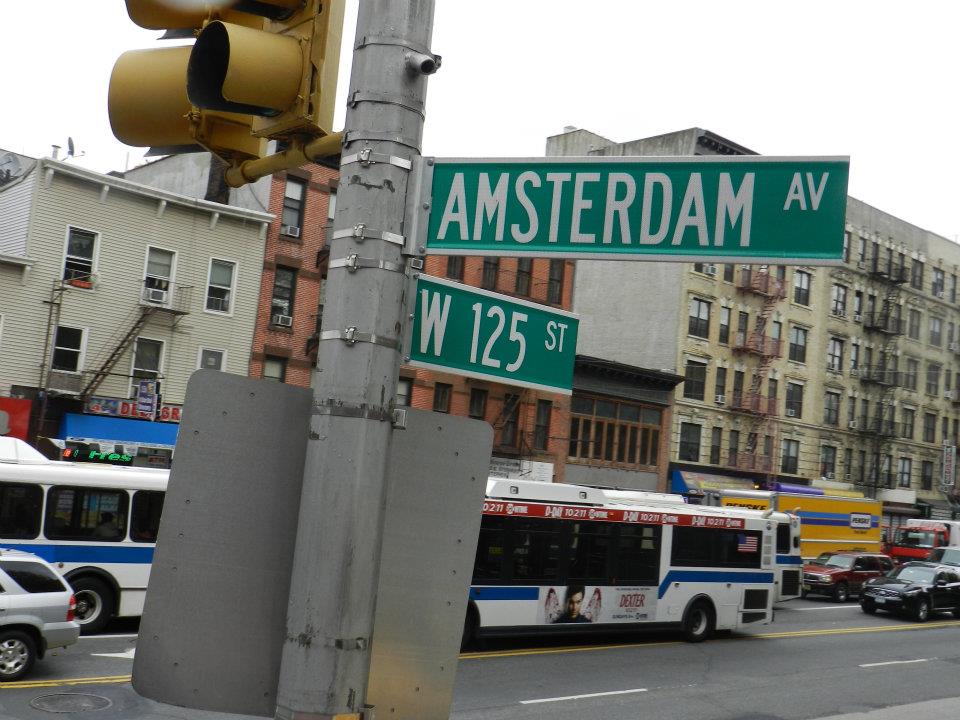
Martin Luther King, Jr. Blvd.: For your information, 125th Street is a two-way street that runs east-west in Manhattan, and it is considered the "Main Street" of Harlem. It is also known as Martin Luther King, Jr. Boulevard.

As of 2011, former president Bill Clinton maintains an office on 125th Street.

Apollo Theater


Apollo Theater: The Apollo Theater is  one of the oldest and most famous music halls in the United States, and the most famous club associated almost exclusively with African-American performers. 

It is located at 253 W. 125th Street in Manhattan, specifically in Harlem, one of the United States' most historically significant traditionally African-American neighborhoods.

Through the Years: The Apollo Hall, as it was known in the early years, was founded in the mid-19th century by a former Civil War General as a dance hall and ballroom. At the end of his lease in 1872, it was converted to a theater, which closed shortly before the turn of the 19th to 20th century.  The name "Apollo Theater" lived after being purchased again in 1913-1914 when it was opened as a burlesque theater. It remained in operation as such until 1928, when it was repurchased and reopened many times later through out the years.  Following the World War I era the Harlem Renaissance was occurring at the time and there was a Great Migration of blacks from the southern states, and in the mid-1930's it was opened with "a colored review" with all proceeds donated to the Harlem Children's Fresh Air Fund. The owner at the time, Schiffman's motivation for featuring Negro talent and entertainment was not only because the neighborhood had become Negro over a long period of gradual migration, but because colored entertainers were cheaper to hire, and Schiffman could offer quality shows for reasonable rates. There are precisely 1,506 seats in the Apollo Theater.  For many years, Apollo was the only theater in New York City to hire black people. 

Notable Appearances: In November of 1934, the late Ella Fitzgerald made her singing debut at age 17 at the Apollo. It also became famous for launching the careers of artists such as Fitzgerald, Billie Holiday, James Brown, Diana Ross & The Supremes, Gladys Knight & the Pips, The Jackson 5, Patti LaBelle, Marvin Gaye, Luther Vandross, Stevie Wonder, Aretha Franklin, Ben E. King, Mariah Carey, The Isley Brothers, Lauryn Hill, Sarah Vaughan.  Jimi Hendrix won the first place prize in an amateur musician contest at the Apollo in 1964. During an appearance at the Apollo in January 2012, President Barack Obama sang the opening line of Al Green's "Let's Stay Together."  It was also recently announced that Bruce Springsteen and the E Street Band will be playing the Apollo on March 9, 2012 in a private concert for Sirius XM.   


United House of Prayer for All People in Harlem

The United House of Prayer for All People in Harlem: The United House of Prayer for All People (also known as United House of Prayer for All People of the Church on the Rock of the Apostolic Faith) (now that is a mouthfull!) is a Christian denomination founded in 1919. 
According to church literature and their official website, the United House of Prayer for All People has 131 places of worship in 26 states. The church has an estimated membership of 1.5 million. The church is known for its periodic mass baptisms by fire hose which started around the 1920s by the founder and also for its shout bands. 

Statue in Harlem

Statue at Right: I am sorry to say that I cannot remember who the statue at right of the woman and child is.  Nika recalls that it was dedicated to a woman who was a matriarch in New York for taking in or starting up a safe haven for abused women in relationships and/or for children who were born drug-dependent from drug-abusing mothers.  All the research I have done and even calls to the Gray Line Tours to identify this woman have been futile.  But for now, even though, I don't have a name to put to her face, she is still considered a hero.

Malcolm Shabazz Outdoor Market in Harlem
Malcolm Shabazz Harlem Market: (See pics at left and below) This colorful market with the mosque-looking structure, located at 52 W. 116th St. in Harlem, is full of fabulous traditional African crafts and textiles which include hair-braiding boutiques, urbanwear, large selection of carved wooden figurines, and handmade African-style clothes for men, women, and children. Occasionally Saturday is a giveaway day.  I am told that it is the place to go with little money and that haggling is appropriate.  It is open seven days a week, but apparently the amount of vendors selling on Sundays is a bit thinner, since Harlem is a very hugely religious sector, so many are attending services.

Just east of Malcolm X Boulevard, this outdoor soiree specializes in colorful African goods. Vendors hail from countries like Senegal, Nigeria, Kenya and Ghana hawk exotic pieces that are native to their homelands.  It is open from 10:00 a.m. to 8:00 p.m., year-round.

Duke Ellington statue
Duke Ellington Sta


Duke Ellington statue: (See pics to left above and right).  A statue of Duke Ellington stands in Duke Ellington Circle, which is a shallow amphitheater at 110th Street and Fifth Avenue in Harlem, at the northeast corner of Central Park. 

Description: This monumental piece unveiled in 1997, standing  at 25 feet tall, depicts the composer, pianist and bandleader Edward Kennedy ("Duke") Ellington standing beside a concert grand piano, upon a base supported on the heads of nine nude caryatids, who are better known as The Muses.  This statue is set within a multi-leveled semi-circular plaza at the gateway to Harlem --the community in which Ellington lived for much of his adult life and with which he is creatively associated.


What are The Muses: The supporting columns of the grand concert piano are nine nude caryatids depicting The Muses.  A caryatid is a female-shaped supporting pillar; a column in the shape of a draped female figure supporting a structure such as the porch of a classical Greek temple.  In this case, these caryatids represent The Muses which, in Greek mythology, poetry, and literature, are the goddesses who inspire the creation of literature, science and the arts.  They were considered the source of the knowledge, retold for centuries in the ancient culture, that was contained in poetic lyrics and myths. They are considered a compliment to a real woman who inspires creative endeavor. Born the nine daughters of Zeus and Mnemosyne, they personify knowledge and the arts, especially literature, dance and music. It was not until Roman times that the following roles were assigned to them: Calliope -epic poetry (centered around a hero); Clio -history; Euterpe -flutes and lyric poetry; Thalia -comedy and narrow-minded poetry; Melpomene -tragedy; Terpsichore -dance; Erato -love poetry; Polyhymnia -sacred poetry; Urania -astronomy.

Significance and Association with Harlem: The sculpture of Duke Ellington is the first monument in New York City dedicated to an African American and the first memorial to Ellington in the United States. A composer, orchestra conductor, and musician, Ellington elevated jazz to the top. The December 1927 opening at the Cotton Club which was the biggest of the Harlem speakeasies is what put the Duke Ellington Orchestra on the jazz map. With Harlem and the Cotton Club as home base, Ellington began radio broadcasts and recorded for American, English, and French labels. Duke was at his most creative era from 1930-1942 , composing such classics as Mood Indigo and Don't Get Around Much Anymore.  He also received the Presidential Medal of Freedom in 1969.

Statue of Dr. Marion Sims
Dr. J. Marion Sims Statue: Dedicated in 1894, this bronze and granite monument stands on the perimeter of Central Park in honor of Dr. James Marion Sims.  A renowned surgeon, Sims is regarded as the father of American gynecology. Sims’ work is credited for giving the field status as a separate medical specialty, which all of us women can be truly thankful for today. He founded a hospital for women in New York and then become president of the American Medical Association. Celebrated while alive for his medical contributions, he has since become a controversial figure for his use of slave women as experimental subjects.

Guggenheim (to the right)
Guggenheim Museum (The picture at right shows the Guggenheim at the far right).  Designed by architect Frank Lloyd Wright, the Solomon R. Guggenheim Museum (more popularly known as "The Guggenheim")  is a well-known museum located on the Upper East Side of Manhattan.  It is admired as much for its architecture as its art and  it is one of the 20th century's most important architectural landmarks. The bright white exterior and glass-domed interior give the museum a modern, clean feel. Most noted here is the "Great Rotunda," which has played home to many exhibitions. It now has a ten-story tower; giving the museum extra space and it also contains a sculpture collection and a cafe overlooking Central Park .  It is the permanent home to a renowned collection of Impressionist, Post-Impressionist, early Modern, and contemporary art and also features special exhibitions throughout the year. The museum opened on October 21, 1959, and from 2005 to 2008 it underwent an extensive renovations.  Recently, it is undergoing, again, more extensive renovations and that is what was happening on the day we went there.  Upon entering we found out that most (75%) of the architectural details of the interior of the building and its displays would not be on our tour, so we decided to skip this museum all together. 

The Guggenheim has become a cultural icon and can be seen widely throughout popular movies and television shows.  It was featured in such greats as Bye Bye Birdie, Men in Black, When in Rome, and Ugly Betty; and prominently in The International, where a major shootout occurs in the museum. In fact, a life-size replica of the museum was built for this scene.  The film, Mr. Popper's Penguins has a sequence where the penguins cause a disturbance entering the museum, wander to the top of the gallery structure and slide down the entire spiral structure to the ground floor.

Metropolitan Museum of Art
The "Met
Metropolitan Museum of Art:  I am told that any visitor to the "Big Apple" should spend at least a couple of hours at this vast museum.  Although it was on our list of “to-see” places, unfortunately we were not able to fit it into our schedule.  (See pics to left and below-right).

The Metropolitan Museum of Art (commonly referred to as “The Met”) is a renowned art museum  located on the eastern edge of Central Park along Manhattan's Museum Mile (5th Avenue and 82nd Street), and is one of the world's largest art galleries. Its permanent collection contains more than two million works, divided into nineteen departments.  The Met measures almost 1/4-mile long and occupies more than 2 million square feet with more than 1.5 million square feet of exhibition space.  It was founded in 1870 by a group of American citizens, who included businessmen and financiers, as well as leading artists and thinkers of the day, who wanted to open a museum to bring art and art education to the American people. It opened in February 1872, but was originally located at 681 Fifth Avenue

European paintings on display include works by Monet, Degas, and Van Gogh. The Egyptian gallery is considered unparalleled.  It also has many displays of Asian art, sculpture, armory, and photography. During warm weather, the open-air roof garden displays contemporary sculptures. It also contains an extensive collection of American and modern art and maintains extensive holdings of African, Asian, Oceanic, Byzantine, and Islamic art.  It also houses collections of musical instruments, costumes and accessories, and antique weapons and armor from around the world.
 

The "Tornado" Statue
"Tornado" Statue:  This statue was located at the south part of Central Park just across the street from the Plaza Hotel. The Tornado was a new commission that rose to more than 30 feet in height, but if you hadn't seen it in person before, you will not see it there again as it was only on display in Central Park until February 19, 2012.  It visualizes a densely packed storm system, rising to more than 25 feet and features some approximately 100 distinct "clouds" made of inflated truck inner tube tires securely individually to a steel structure. Inspired by high velocity winds and the raw power associated with the weather phenomena of tornadoes, it rustles in the wind creating a dynamic, kinetic sculpture. 

 Central Park Carriage Rides: Horse-Drawn Carriages are a unique and wonderful way to experience the beauty of Central Park.  These horse and buggies can be found all year round lined up along Central Park South between 5th and 6th Avenues.

Horse-Drawn Carriages Lined Up by Central Park
In New York City, horses are a symbol of a bygone era before the convergence of cars, buses and trains.  It was during this time that New Yorkers got around from place to place on horseback or by means of horse-drawn carriage. As a result and over time, horses became iconic to the history of Manhattan.  New York City law restricts that no carriage may operate above 89 degrees or below 19 degrees or during Blizzards.  Ride lengths range from 30 minutes to 3 hours.

One of the items on our (my) itineary for Friday night was for the three of us to take a horse-drawn carriage ride through Central Park to experience its virtues.  But the weather that night was nasty, rainy and a little chilly, plus with all our bags (okay, my bags) it would have been a little cumbersome.  Another item to put on my to-do list on my next visit to NYC!

Jose Julian Marti Monument
Jose Julian Marti Monument:  Martí , a Cuban patriot, journalist and poet, fought for the liberation of Cuba from Spanish rule and was an important figure in Latin American literature. The statue shows the moment when Martí was mortally wounded in battle.  


In his short life of 42 years, José Julián Martí Pérez laid claim to being a poet, essayist, journalist, revolutionary philosopher, translator, professor, publisher, and a political theorist.  Through his many writings and political activity, he became a symbol for Cuba's bid for independence against Spain and is often referred to as the "Apostle of Cuban Independence." Also fighting against the threat of United States expansionism into Cuba, he dedicated his life to the promotion of political independence for Cuba and independence for all Spanish Americans.  His death was decreed as a cry for Cuban independence from Spain.  Considered a liberal, he fought for the idea that it was unnatural for Cuba to oppressed and controlled by Spain. 

Martí campaigned for the liberation of Cuba from Spain and was imprisoned by Spanish authorities in 1868. Fleeing to New York in 1880, he continued to advocate for Cuban freedom while in exile and organized the Cuban Revolutionary Party in 1892. Martí returned to Cuba in 1895, at the beginning of Cuba’s successful fight for independence. The monument depicts a reeling Martí after being fatally wounded while atop his horse during the 1895 battle at Dos Rios. Although the statue was completed in 1959, the political climate between pro- and anti-Castro elements in New York necessitated the delay of the monument’s unveiling until 1965.

Created by sculptor Anna Hyatt Huntington, this was her last major work, at the age of 82, and it was presented as a gift to the Cuban government for presentation to the people of New York City.

The piece is one of a trio of bronze equestrian sculptures representing Latin-American leaders that greet visitors to Central Park at the north end of Avenue of the Americas, which was named in 1945 at the suggestion of Mayor Fiorello H. LaGuardia to honor Pan-American ideals and principles. Following the renaming of Sixth Avenue, a new plaza was designed where the avenue meets Central Park, and the monument of Simon Bolivar (mentioned in my previous posts) was moved to the eastern side of the plaza and rededicated. A month later the statue of Argentine general José de San Martín (below) was unveiled on the west side of the plaza, and in 1965, the Marti monument was dedicated between the two earlier monuments.

José de San Martín Statue in Central Park
José de San Martin Statue. Located in Central Park's Bolivar Plaza, this heroic bronze equestrian statue depicts Argentine general José de San Martín, who helped Argentina, Chile, and Peru gain independence from the Spanish in the early part of the 19th century.  José Francisco de San Martín, known simply as Don José de San Martín , was an Argentine general and the prime leader of the southern part of South America's successful struggle for independence from Spain.

"You Dirty Rat!"

Oh, oh, it is the Giant Inflatable Rat! Someone hasn't been nice! A ''rat contractor'' is an old phrase in construction and can refer to an employer who is not providing proper safety equipment, benefits or wages. When the union (in this case, Construction and General Building Laborers Local 79) gets a complaint, if the job site isn't one the union is already monitoring, the union research department checks it with the reports all contractors are required to file with the city.  And onto the job site goes the Big Rat.  The actual decision to send out one of the gray, red-eyed, snarling rats is usually made by Local 79's market development department. Since I work for a labor and employment (employee rights) law firm, all I can say is, best be nice, you dirty rat!


Playwright Tavern:  The Playwright Tavern, located in the heart of the Times Square in the exciting Theater District, at 202 West 49th Street, offers up delicious Irish-American cuisine. Serving New York since 1995, this three level Irish restaurant and bar is a regular stop off for theater goers before and after a Broadway or Radio City Music Hall show.  It is also conveniently located just minutes from Rockefeller Centre and St. Patrick's Cathedral.


Times Square: As we are getting back to Times Square on the end of this loop for today, I'm taking pictures of many of the fabulous sights there.  There is so many sights to see that it seemed as though my camera crawled out of its case, lept out of my hand and started clicking away.  So I need to share some of these with you.

One of the places, which we didn't get to but is on my "next" list, was Madam Toussard's Wax Museum.  I was taken back by the unique structure that houses this museum with its fanciful hands reaching out way up high and way down low.
+
M&M's World
M&M's Electronic Billboard

M&M's World: What is a trapse through Times Square without snapping a picture or two of the sign and billboards at M&M's World Store. M&M's World is a retail store that specializes in everything from M&M's candy to M&M's clothing. Opening in 2006, the New York City location within a 24,000-square-foot, three-level glass box. It includes a 50-foot-wide, two-story-high, "wall of chocolate", made up of 72 continuous candy-filled tubes. M&M's World in Times Square is New York City's largest candy store, and offers merchandise such as themed clothing, dishware, watches, and piggy banks. Before it opened in 2006, nearly 13,000 people lined up for the 198 jobs, which were in demand because of a more generous health benefit package than is usually offered for an entry-level retail job in New York.  A tidbit of interest:  In June 2011, M&M's World Store in London opened to the public and it has now been dubbed the world's largest candy store, at 35,000 sq. ft.

M&M's Electronic Billboard
Madame Tussauds Wax Musuem: I'm facsinated by this museum.  It is totally funky from head to toe. In this case, there is one hand coming out the top which appears to be holding the string to a yo-yo and at the bottom (street level) the hand there materalizes to catch the spun-out yo-yo. 
Madame Tussauds at street level

The Upper Hand at Madame Tussauds
So enchanting and cool, isn't it! I'm fascinatingly infactuated!
Full View of Madame Tussauds

Lower Hand at Madame Tussauds


Chevy's Mexican Restaurant


Villa Pizza Man


More, More, More: We are passing by a couple restaurants whose signage in front magnetize me.  I won't try to clutter today's post up with much more clicks here and there.  But don't you agree that the "Chevy's" sign and the "Villa Pizza Man" catch your attention, too!

New Amsterdam Theater: the famous New Amsterdam Theater.  Built in 1903, at the time of construction, it was the largest theatre in New York with a seating capacity of 1,702. Along with one other theater, which was also built in 1903, the New Amsterdam is the oldest surviving Broadway venue still in use today. It was currently presenting the musical Mary Poppins.

For many years, it hosted the famous Ziegfeld Follies.  The Great Depression took its toll on the theatre business, and in 1936 the New Amsterdam closed, but reopening on a limited basis in 1937 and was soon converted to a movie theatre.  It was purchased in 1982 but would not be completely rehabilitated until eight years later when in 1990, after a court battle, the State and City of New York assumed ownership of the New Amsterdam and many other theatres on 42nd Street. Disney Theatrical Productions signed a 99 year lease for the property in 1993. The theatre, which had recently been used as a filming location for the movie Vanya on 42nd Street, was in shambles; it would take several years and millions of dollars, to restore it to its original usage and grandeur.  It was officially reopened in April 1997. In November 1997, after the premiere of the film Hercules and a limited engagement of a concert version of King David, Disney's stage version of The Lion King opened. In June 2006, The Lion King closed in The New Amsterdam Theatre and in November 2006, Mary Poppins opened.

Nika Shopping in Forever 21, Times Square
Nika Shopping: We are now done with today's bus tour and Nika still needs to find a dress for tonight's Wicked. Since it was still misty out, like drowned little mice, we left our rain ponchos on and headed into Forever 21 to peer around some more.  Not working far from this store, Casey eventually caught up with us and helped Nika find a fascinating dress for our big evening out.  


So off to the hotel we go.  Onward to get spiffed up and put our glamour on.  My stomach is doing cartwheels at the thought of seeing my first Broadway play.  


Now, I will sign off because I have to get dressed.  The next post you will read will be all about Wicked.  I can hardly wait! 


Thursday, February 23, 2012

The Big Apple: Day Deux, Part 2 (The Dakota to Peace Fountain)

Whew, so we made it through the first part of the second day's tour.  Are you rested up and ready to set sail again? Now, without further delay, let's jump right back on the Gray Line bus and continue on where we left off from Day 2, Part 1.  Here it is: Day 2, Part 2, starts now ---

The Dakota
The Dakota/ Strawberry Fields: The Dakota building [at left] was the home of former Beatle John Lennon from 1973 on, and was the location of Lennon's murder by Mark David Chapman on December 8, 1980. As of 2010, Lennon's wife, Yoko Ono, still has several apartments in the building. 

In the film Rosemary's Baby, The Dakota is used for exterior shots of the apartment building where the couple lives, in the film their home was known as the "Bramford."


Monday, February 13, 2012

The Big Apple: Day Deux (2), Part 1 (Uptown: Hearst Tower to Hell's Kitchen)

It is Day 2 of my big trip and have we got some sights to see today. This is actually the first full sightseeing day, so we need to start packing in plenty of adventure with a capital "A" for today.

As you will recall from my post about Day 1, the day before I snagged two passes, one for Nika and one for me (since Casey would be at work during the day), to do the Gray Line Tours. I didn’t quite know what to expect so this, in itself, was going to be an adventure. After seeing Casey off to work, Nika and I snatched food from the complimentary breakfast in our hotel (what a feast they had!), showered and got ready to head out. We stopped at the front desk to print out the voucher for the Gray Line Tour. Grabbing my camera and small shoulder bag (this was quite a feat for me to pare down my usual large purse to a small one, but I did it), and off we went like a couple of characters from the Wizard of Oz setting out to find the Great Wizard himself. And, really, we were! As we were heading out during the morning rush of people swarming the sidewalks, we toddled along arm-in-arm – she the worldly Brooklyn girl, and me the hick with the big eyes taking in any and every sight along the way. Even on these walks, the camera is never in its case. It is posed and ready to snap a pic at any moment. So with umbrella in our intertwined hands, camera in another and coffee in the third appendage, we're off to find some "treasure."

Our destination: the Gray Line Visitor Center located at 777 8th Avenue at 47th Street. Here we would exchange the voucher for our boarding passes. As I relinquished control to Nika to get us to 8th at 47th, my camera never stopped clicking at the sights around me. This may be my only chance to ever get there and I was going to make the most of taking pictures to savor at later dates.

Gray Line Tours:
Once we arrived at Gray Line Tours Visitor Center, we next had to decide which tour we were going to take today. The package I purchased included three days of tours for the two of us, and each ticket included entrance to three sites. [The picture at left shows the map and what all the tours cover.]

Looking back now I will say there is no better way to travel than to have a carefree transfer waiting for you upon arrival to navigate you through the New York traffic where you can hop on and hop off at any stop. Acquainting myself (ourselves) with New York City with an unrivaled Gray Line sightseeing tour was one of the best ideas. We found that no where else could we experience the incredible architecture of many of New York’s main attractions, in a short period of time.

Today, we decided to do the Uptown Loop Tour. The brochures told us the duration of this was a 2-3 hour loop (without any stops). The stops on this loop included Central Park West, Lincoln Center, Dakota Apartments, American Museum of Natural History, Cathedral of St. John the Divine, Grants Tomb, Apollo Theater, Harlem Market, The Museum Mile, Guggenheim, Metropolitan Museum, Central Park and Fifth Avenue.

Uptown loop, here we come. We headed outside to jump on the next double-decker bus that was leaving. As we had discussed while inside at the visitor center, today’s adventure would have to be timed just right. That night we were going to see the Broadway play “Wicked” at the Gershwin Theater, so we figured we would have to be back to the hotel between 5:00 and 6:00 at the latest in order to get ready and head out to the play in time.

Onto the bus we climbed and immediately headed up to the top of the open double-decker bus. It had started raining slightly -- more of a heavy mist -- so we were given and donned some fashionable rain slickers. [See picture at left of Nika modeling our fashionable attire; as you can see in the picture, everyone was wearing them so we weren't the only alien-looking people on the bus.]

Now, let’s start our tour. As we go along, I intend to give you information about some of the sites we saw. Our guides on each bus filled us in with tons of information and it makes each sight all the more exciting to know all the information behind the sight/building.

Hearst Tower
: First up, the Hearst Tower. [See pic at left.] The city's first new energy-efficient tower constructed in 2006 over the original six-story preserved Hearst Building originally constructed in 1928.

Hearst Tower, located in Midtown Manhattan at 300 West 57th Street, is another example of the new breed of green design skyscrapers in New York City. It is a glass and steel construction skyscraper which rests on the base of the original 1920's Hearst Corporation Building. Hearst Tower is easily identified by the dramatic interlocking triangular glass panels. Interesting note: It was also the first skyscraper in New York City to be awarded the coveted Gold LEED Certified rating by the United States Green Building Council.

40 Wall Street (a/k/a The Trump Building) [Sorry, I thought I had taken a picture of this historic building, but didn't find one. I will, however, tell you about this iconic sight.]

History: 40 Wall Street is a 70-story skyscraper; originally known as the Bank of Manhattan Trust building, and also known as Manhattan Company Building, it was later known by its street address when its founding tenant merged to form the Chase Manhattan Bank and today is officially named the Trump Building. The building, between Nassau Street and William Street in Manhattan was completed in 1930 after only 11 months of construction. Its pinnacle reaches 927 feet and was very briefly the tallest building in the world, soon surpassed by the Chrysler Building finished that same year. [Make note here that throughout describing some of the larger buildings in New York City, I will mention the status of height boasting rights -- who is tallest then/now/when.] Because this building has so much history, I wanted to share all the interesting facts about it with you.

Construction: Construction of the Bank of Manhattan Building at 40 Wall Street began in 1928, with a planned height of 840 feet, making it 135 feet taller than the nearby Woolworth Building, completed in 1913. More importantly, the plans were designed to be two feet taller than the Chrysler Building, which was in an apparent competition to be the world’s tallest building. In order to stay ahead of the race, the architects of 40 Wall Street changed their originally announced height of 840 feet or 68 stories, to 927 feet or 71 stories, making their building, upon completion in May 1930, the tallest in the world. However, this triumph turned out to be short-lived.

Chrysler Building Competes: Uptown at 405 Lexington Avenue, the Chrysler Building developers were in the works to top 40 Wall Street. By October 1929, tycoon Walter Chrysler used his secret weapon to win the race to the top; a 125-foot (38 m) stainless steel spire was clandestinely assembled in the Chrysler Building's crown and hoisted into place, bringing it to a height of 77 stories, or 1,048 feet (319 m). Once completed on May 28, 1930, the Chrysler Building surpassed 40 Wall Street as the tallest building on the earth, fulfilling tycoon Walter Chrysler's dream.

Taking It To The Papers: Upset by Chrysler’s victory, Shreve & Lamb, consulting architects of 40 Wall Street, wrote a newspaper article claiming that their building was actually the tallest, since it contained the world's highest usable floor. They pointed out that the observation deck in the Bank of Manhattan Building was nearly 100 feet above the top floor in the Chrysler Building, whose surpassing spire was strictly ornamental and essentially inaccessible. However, such trivialities became a moot point when the Empire State Building was completed eleven months later in 1931, becoming the world’s tallest building at 1,250 feet (380 m) in both of those categories.

1946 Airplane Crash Into 40 Wall Street: On the evening of May 20, 1946, a United States Army Air Forces C-45 Beechcraft airplane crashed into the north side of the building. The twin-engined plane was heading for Newark Airport on a flight originating at Lake Charles Army Air Field in Louisiana. It struck the 58th floor of the building at about 8:10 p.m., creating a 20 by 10-foot hole in the masonry, and killing all five aboard the plane, including a WAC officer. Fog and low visibility were identified as the main causes of the crash. At the time of the accident, LaGuardia Field reported a heavy fog that reduced the ceiling to 500 feet, obscuring the view of the ground for the pilot at the building's 58th story level. Parts of the aircraft and pieces of brick and mortar from the building fell into the street below, but there were no reported injuries of any of the estimated 2,000 workers in the building, nor anyone on the street.

This crash at 40 Wall Street was only the second of its kind in New York City's history, the first being when an Army B-25 bomber struck the 78th floor of the Empire State Building in July of the year before. The cause of that crash was also fog and poor visibility. The 1946 incident was the last time an airplane accidentally struck a skyscraper in New York City until October 11, 2006, when a small plane carrying New York Yankees pitcher Cory Lidle slammed into a 50-story condo building on Manhattan's Upper East Side.

1982 Purchase by Marcos: In 1982, Joseph J. and Ralph E. Bernstein purchased 40 Wall Street and were later found to be acting on behalf of Ferdinand E. Marcos, the late President of the Philippines. When Marcos was removed from power and his assets in the United States were frozen, the building was placed in limbo. [Of course, you have to recall his widow, Imelda Marcos who is often remembered for symbols of the extravagance of her husband's political reign, which included her collection of 2,700 pairs of shoes. My hero!!! haha! Okay, so I am a long way from catching her, I only have 100 pairs.]

1995 Purchase by Trump: In 1995, after years of neglect, 40 Wall Street was bought by Donald Trump and later renamed The Trump Building. He planned to convert the upper half of it to residential space, leaving the bottom half as commercial space. However, the cost of converting it to residential space proved to be too high, and it remains 100% commercial space. He tried to sell the building in 2003, expecting offers in excess of $300 million. Such offers did not materialize, and Trump still retains control of the building. In 1998, the building was designated a landmark by the New York City Landmarks Preservation Commission. The tower is the tallest mid-block building in New York City.

Columbus Circle: Columbus Circle, named for Christopher Columbus, is a major landmark and point of attraction in the borough of Manhattan, located at the intersection of Eighth Avenue, Broadway, Central Park South (West 59th Street), and Central Park West, at the southwest corner of Central Park. It is the point from which all official distances from New York City are measured. The name is also used for the neighborhood a few blocks around the circle in each direction. To the south of the circle lies Hell's Kitchen, also known as "Clinton", and the “Theatre District,” and to the north is the Upper West Side.

History: Completed in 1905 and renovated a century later, the circle was designed by Wm. Eno as part of Frederick Law Olmsted's vision for Central Park, which included a "Grand Circle" at the Merchants' Gate, its most important Eighth Avenue entrance.

Columbus Statue: [See up-close pic of Columbus statue at left.] The monument at the center of Columbus Circle was erected as part of New York's 1892 commemoration of the 400th anniversary of Columbus' landing in the Americas. Constructed with funds raised by Il Progresso, a New York City-based Italian-language newspaper, the monument consists of a marble statue of Columbus atop a 70-foot granite rostral column decorated with bronze reliefs representing Columbus' ships: the Niña, the Pinta, and the Santa María. Its pedestal features an angel holding a globe.

Renovations to the circle completed in 2005 included new water fountains, wooden benches, and plantings encircling the monument. The inner circle measures approximately 36,000 square feet and the outer circle is approximately 148,000 square feet.

Time Warner Center, [which I describe more fully further down], the world headquarters of the Time Warner corporation, is located on the west side of Columbus Circle on the site of the old New York Coliseum. The complex also hosts the Shops at Columbus Circle, Jazz at Lincoln Center, the New York City studio headquarters of CNN and the Mandarin Oriental, New York hotel. On the north side of Columbus Circle is the Trump International Hotel and Tower, with its noted steel globe. This building had been an office tower, the headquarters of the Gulf + Western conglomerate, which was stripped to its steel skeleton and reclad in a new facade.

Merchant's Gate: On the northeast lies the Merchant's Gate to Central Park and is dominated by the USS Maine National Monument, a gorgeous and imposing edifice of marble and gilded bronze, which was built in 1913 as a memorial to sailors killed aboard the battleship USS Maine, whose mysterious 1898 explosion in Havana harbor precipitated the Spanish-American War. [Also described more fully below.]

The address 2 Columbus Circle is where Actors' Equity was founded in 1914, in the old Pabst Grand Circle Hotel, a building torn down in 1960 in order to construct a distinctive new tower to house the Huntington Hartford Gallery of Modern Art. Vacant since the city's Department of Cultural Affairs departed in 1998, it was listed as one of the World Monuments Fund's "100 most endangered sites." The building's radical transformation into the new home for the Museum of Arts & Design continues to raise hackles for the failure of the city's Landmarks Preservation Commission to hold hearings on its worthiness for designation. [Sorry, but I didn't capture a picture of this "radical" looking building.]

240 Central Park South, the 1941 balconied modern apartment building across Broadway from the museum, is a city-designated landmark with a new addition atop its retail base -- a green roof. [And, I was positive I had a pic of this building with the green roof, but guess I don't have that either.]

One more bit of info about Columbus Circle -- it also appeared in the movie Ghostbusters as the site where the Stay Puft Marshmallow Man begins his trip towards 55 Central Park West. I have always loved that scene.

USS Maine National Monument at the Merchant's Gate entrance to Central Park: The USS Maine was the United States Navy's second commissioned pre-dreadnought battleship, although she was originally classified as an armored cruiser. She is best known for her catastrophic loss in Havana harbor. Maine had been sent to Havana, Cuba to protect U.S. interests during the Cuban revolt against Spain. On the evening of February 15, 1898, she suddenly exploded, and swiftly sank, killing nearly three quarters of her crew. Though then, as now, the cause and responsibility for her sinking were unclear, popular opinion in the U.S. blamed Spain, and the sinking (popularized in the phrase "Remember the Maine, to Hell with Spain!") was one of the precipitating events of the Spanish–American War. Her sinking remains the subject of speculation, with various opinions proposing that she sank due to the results of an undetected fire in one of her coal bunkers, that she was the victim of a naval mine, and that she was deliberately sunk for the purposes of driving the U.S. into a war with Spain. This gorgeous piece of work [see picture at left above] is glorious to see.

Time Warner Center: Time Warner Center is a mixed-use skyscraper at Columbus Circle on Manhattan's Upper West Side. It has attracted much attention as the first major building to be completed since the 9-11 terrorist attacks and has become known to many New Yorkers as the "new twin towers." Additional publicity was generated in 2003 when David Martinez paid $45 million dollars for a penthouse condominium, a record for New York residential sales. It's design consists of two 750 ft towers bridged by a multi-story atrium containing upscale retail shops. Construction began in November 2000, following the demolition of the New York Coliseum, and a topping-out ceremony was held on February 27, 2003. The property had the highest-listed market value in New York City, $1.1 billion, in 2006.

Originally constructed as the AOL Time Warner Center, the building encircles the western side of Columbus Circle and straddles the border between Midtown and the Upper West Side. The total floor area of 2.8 million square feet is divided between offices (notably the offices of Time Warner Inc.), residential condominiums, and the Mandarin Oriental, New York hotel. The Shops at Columbus Circle is an upscale shopping mall located in a curving arcade at the base of the building, with a large Whole Foods Market grocery store in the basement. As well as CNN studios, the complex is also home to a 1,200 seat theater for Jazz at Lincoln Center; as of August 2011, Jazz at Lincoln Center's The Allen Room is the recording studio for Anderson Cooper's daytime talk show, Anderson. CNN's Jeanne Moos, known for her offbeat "man on the street" reporting, frequently accosts her interview subjects just outside the building. In 2005, Jazz at Lincoln Center announced a partnership with XM Satellite Radio which gave XM studio space at Frederick P. Rose Hall to broadcast both daily jazz programming and special events such as an Artist Confidential show featuring Carlos Santana.
Steel Globe: On the north side of Columbus Circle is the Trump International Hotel and Tower, with its noted steel world globe honoring Christopher Columbus’ discovery of the New World. [See photo at left .]

Trump International Hotel and Tower: The Trump International Hotel and Tower is a high-rise building, located at 1 Central Park West on Columbus Circle between Broadway and Central Park West, in Manhattan, New York City. The building has 44 floors. [See picture below, left.]

It is owned by The Trump Organization and features hotel rooms and residential condominiums. The building was originally the Gulf and Western and was built in 1969. Between 1995-1997, the building was stripped to its skeleton and given a new facade. The building is used as the setting of the 2011 comedy crime film Tower Heist, which I have not seen yet (at this writing), but hope to soon.

Hell’s Kitchen:
Hell's Kitchen, also known as Clinton and Midtown West, is a neighborhood of Manhattan in New York City between 34th Street and 59th Street, from 8th Avenue to the Hudson River.

The neighborhood provides transportation, hospital and warehouse infrastructure support to the Midtown Manhattan business district. Its gritty reputation depressed real estate prices in the area relative to much of the rest of Manhattan until the early 1990's. Since then, rent prices have increased enormously, with current rent prices above the Manhattan average.

Why the Name? Several explanations exist for the original name. An early use of the phrase appears in a comment Davy Crockett made about another notorious Irish slum in Manhattan, Five Points. According to the Irish Cultural Society of the Garden City Area when, in 1835, Davy Crockett said, "In my part of the country, when you meet an Irishman, you find a first-rate gentleman; but these are worse than savages; they are too mean to swab hell's kitchen." He was referring to the Five Points.

According to an article by Kirkley Greenwell, published online by the Hell's Kitchen Neighborhood Association, no one can pin down the exact origin of the label, but some refer to a tenement on 54th Street as the first "Hell's Kitchen." Another explanation points to an infamous building at 39th as the true original. A gang and a local dive took the name as well. A similar slum also existed in London and was known as Hell's Kitchen.

Local historian Mary Clark explained the name, first appearing in print on September 22, 1881, when a New York Times reporter went to the West 30's with a police guide to get details of a multiple murder there. He referred to a particularly infamous tenement at 39th Street and 10th Avenue as "Hell's Kitchen," and said that the entire section was "probably the lowest and filthiest in the city." According to this version, 39th Street between 9th and 10th Avenues became known as Hell's Kitchen and the name was later expanded to the surrounding streets. Another version ascribes the name's origins to a German restaurant in the area known as Heil's Kitchen, after its proprietors. But the most common version traces it to the story of Dutch Fred The Cop, a veteran policeman, who with his rookie partner, was watching a small riot on West 39th Street near 10th Avenue. The rookie is supposed to have said, "This place is hell itself," to which Fred replied, "Hell's a mild climate. This is Hell's Kitchen.” And, there you have it -- the rest of the story(ies)!

The rough and tumble days on the West Side figure prominently in Damon Runyon's stories and the childhood home of Marvel Comics' Daredevil. Various Manhattan ethnic conflicts formed the basis of the musical and film West Side Story.

Once a bastion of poor and working-class Irish Americans, over the last three decades of the 20th century and into the new millennium, Hell's Kitchen has undergone change as a result of its proximity to Midtown. The 1969 edition of the Plan for New York City book authored by the City Planning Commission stated that people of modest means were being driven from the area by development pressures due to the Midtown location. Today, many actors reside in the neighborhood because it is near the Broadway theaters and Actors Studio training school.

9-11 (2001): While almost all fire stations in Manhattan lost firefighters in the September 11, 2001, terrorist attacks, the hardest hit station was Engine 54, Ladder 4, Battalion 9 at 48th Street and Eighth Avenue, which lost 15 firefighters. Given its proximity to Midtown, the station had specialized in skyscraper fires and rescues and in 2007 was the second busiest firehouse in New York City, with 9,685 runs between the two companies. Also Ladder 21, the "Pride of Hell's Kitchen", located on 38th Street between 9th and 10th Avenues, and stationed with Engine 34, lost 7 firefighters on September 11. In addition, on September 11, Engine 26 was temporarily stationed with Engine 34/Ladder 21 and lost many firefighters themselves.

Where Is It At Exactly: "Hell's Kitchen" generally refers to the area from 34th to 59th streets. Starting west of 8th Avenue, city zoning regulations limit buildings to 6 stories high (although exceptions are often made). As a result, most of the buildings are older, often walk-ups. For the most part the neighborhood encompasses the ZIP codes 10019 and 10036. The post office for 10019 is called Radio City Station, the original name for Rockefeller Center on Sixth Avenue.

Southern boundary: Hell's Kitchen and Chelsea overlap and are often lumped together as the West Side since they support the Midtown Manhattan business district. The traditional dividing line is 34th Street. The transition area just north of Madison Square Garden and Pennsylvania Station includes the Jacob K. Javits Convention Center.

Eastern boundary: The neighborhood overlaps the Times Square theater district to the east at Eighth Avenue. On its southeast border, it overlaps the Garment District also on Eighth Avenue. Here, two landmarks reside - the New Yorker Hotel and the dynamic Manhattan Center building (at the northwest corner of 34th Street and Eighth Avenue). Included in the transition area on Eighth Avenue are the Port Authority Bus Terminal at 42nd Street, the Pride of Manhattan Fire Station (from which 15 firefighters died at the World Trade Center), several theaters including Studio 54, the original soup stand of Seinfeld's Soup Nazi, and the Hearst Tower.

Northern boundary: The neighborhood edges toward the southern boundary of the Upper West Side, and 57th Street is considered by some the traditional northern boundary. However the neighborhood often is considered to extend to 59th Street (the southern edge of Central Park starting at Eighth Avenue) where the avenue names change. Included in the 57th to 59th Street transition area are the Time Warner Center at Columbus Circle, St. Luke's-Roosevelt Hospital Center, where John Lennon died in 1980 after being shot, and John Jay College.

Western boundary: The western boundary is the Hudson River.

Alternate Names: Hell's Kitchen has stuck as the general and informal name of the neighborhood even though real estate developers have offered alternatives of Clinton and Midtown West or even "the Mid-West". The Clinton name, used by the municipality of New York City, originated in 1959 in an attempt to link the area to DeWitt Clinton Park at 52nd and 11th Avenue, named after the 19th century New York governor.

West Side Story: During the 1950s, immigrants, notably Puerto Ricans, moved into the neighborhood. The conflict between the Irish, Italians, and the Puerto Ricans is highlighted in West Side Story. The movie was filmed from 65th Street and 69th Street between Amsterdam and West End Avenue, north of Hell's Kitchen. Part of the sites seen are old P. S. 94 on the corner of 68th Street and Amsterdam Avenue and St. Michael's Church. The movie was filmed during the demolition of this area that was to become Lincoln Center.

In 1959, an aborted rumble between rival Irish and Puerto Rican gangs led to the notorious "Capeman" murders in which two innocent teenagers were killed. By 1965, Hell's Kitchen was the home base of the Westies, a deeply violent Irish American crew aligned with the Gambino crime family. It was not until the early 1980's that widespread gentrification (or the wealthy buying up lower income properties) began to alter the demographics of the longtime working-class Irish American neighborhood. The 1980's also saw an end to the Westies' reign of terror, when the gang lost all of its power after the RICO convictions of most of its principals in 1986.

Today Hell's Kitchen is an increasingly upscale neighborhood of actors and affluent young professionals, as well as residents from the "old days". It has also acquired a large diverse community as residents have moved north from Chelsea. Hell's Kitchen's gritty reputation had made its housing prices lower than elsewhere in Manhattan. Given the lower costs in the past and its proximity to Broadway theaters, the neighborhood is a haven for aspiring actors. Some notables who have resided there, include Burt Reynolds, Rip Torn, Bob Hope, Charlton Heston, James Dean, Madonna, Jerry Seinfeld, Alicia Keys, and Sylvester Stallone. This is due in large part to the Actors Studio on West 44th, which rose to prominence.

With the opening of the original Improv in 1963, the club became a hangout for singers to perform but quickly attracted comedians, as well, turning it into the reigning comedy club of its time. Located on West 44th near the SE corner of 9th Ave, it has since closed, replaced by a restaurant.

The neighborhood is also home to a number of broadcast and music-recording studios, including the CBS Broadcast Center (at 524 West 57th Street), Sony Music Studios (at 460 West 54th Street), Manhattan Center Studios (at 311 West 34th Street), and Right Track Recording's Studio A509 orchestral recording facility (at West 38th Street and 10th Avenue). The syndicated Montel Williams Show is also taped locally at the Unitel Studios, 433 W. 53rd Street, between Ninth and Tenth Avenues.

Comedy Central's satirical program The Daily Show is also taped in Hell's Kitchen. In the summer of 2005, it moved from its quarters at 54th Street and 10th Avenue to a new studio in the neighborhood, at 733 11th Avenue, between 51st and 52nd Streets. The old location at 54th and 10th is now home to The Colbert Report. Next door to Colbert at 511 W. 54th St. is Ars Nova Theater, home to emerging artists such as breakout star Jesse Eisenberg, among others. [You will remember Eisenberg as portraying Facebook co-founder Mark Zuckerberg in the 2010 hit movie "The Social Network."] Loew's Theater[see picture above, left] is also one of the famed attractions in Hell's Kitchen.

The Clinton Community Garden is a result of the actors living in the area. Since they mostly work at night in the local theaters, they took time to create a garden in a rubble-strewn lot. Eventually it became a selling point for gentrification, providing real estate agents with another selling point.

Original Control House on the NY Subway System: [See picture at left]. This picture depicts the New York City's subway original control house (front) and right behind that, with the green stripes on the roof, is the newer Control house, located on opposite sides of 72nd Street.

72nd Street is an express station on the IRT Broadway – Seventh Avenue Line of the New York City Subway, located at the intersection of Broadway, 72nd Street and Amsterdam Avenue (including Verdi Square and Sherman Square) on the Upper West Side of Manhattan. It is served by the 1, 2 and 3 trains at all times.

2nd Street station opened on October 27, 1904, as part of the original subway, with trains running from the Brooklyn Bridge to 137th Street. The original configuration of the station was inadequate by IRT standards. It had just one entrance (the Control house on the traffic island between 71st and 72nd Streets, now listed on the National Register of Historic Places) and the platforms and stairways were unusually narrow. There were no crossovers or crossunders as the control house had separate turnstile banks and token booths for each side.

During the 1950s, the New York City Transit Authority (now MTA) considered converting the station to a local station by walling off the express tracks from the platforms. This would have coincided with 59th Street – Columbus Circle, which is a major transfer point to the IND Eighth Avenue Line, becoming an express stop.

All this may sound confusing, and it should be, as although I found riding on the subway entertaining watching all the different people, finding out where you need to go and getting on which train WAS very confusing to me. My guides, Casey and Nika, made it easy, though, so I didn't have to worry about it. But put me on there by myself and I might be riding all day long before someone tells me I have to get off. Then . . . I would probably be lost! :)

*****

Well, I think I am going to end this portion of the tour here, as it has probably been a lot for you to absorb, as well as for me to write about. But going back over it as I write, it helps me remember all the fascinating things about the many sights I digested during my stay in New York City.

So, goodbye for now. But, remember, Day 2's tour is not over with yet. I have plenty more to share and write about. Day Deux, Part 1, is over . . . now on to Day Deux, Part 2.

Tuesday, January 31, 2012

The Biggest Apple I've Ever Seen -- Day Un (1)

Holy Cow! Did I not tell you about my trip to New York. How can that be? It was the center of my universe for weeks – before and after. Naughty, naughty, naughty. Well, let’s not make that trip and its sensational sights be all for naught. Let me share some of those wonderful events with you now. I have to grab my notes (and go back into some of the blogs I started back in October about this trip but never finished). So time to get them done and out so you can see and hear about it. Here we go -- It's Day One of My Big Adventure, 10-11-11.

Up, Up and Away
. First off, remember me telling you this was my first airplane trip. Well, Tuesday morning brought anxiety before we even hit the tarmac. Nika and I hopped a cab to O’Hare, picking us up at the corner by their apartment. A nice gentleman who, one pressed for conversation, joined in. The one thing he did say that stuck in my mind was “this is the worst I have ever seen traffic” – oh, no!! Oh, yes! He quipped he thought it was all because this was the first business day after a holiday. Monday was Columbus Day and apparently they celebrate that more in Chicago than they do in Madison. Traffic was knee-deep and slowing down every second. The minute we thought we were out of it, back in the thick of it again. Thinking that we were leaving in plenty of time (by Nika’s “watch” as she has driven Casey to the airport many mornings to catch his flights to New York), we hailed the cab at 6:15 a.m., hoping to be at the airport by 7:00. Our flight was leaving at 8:30. Finally breaking through the traffic jams, our trusty driver pulled in and let us off at 8:00. Scramble, we did. And me with all my suitcases! (Evil look from Nika!). I still needed to stop at the bathroom (too much coffee was drank on the ride there), get some water for my cup (to ward off getting dehydrated which pushes me into a low), get some orange juice (to stop a low in case I go into one) and get through — security. Yes, as I mentioned before, my real anxiety was getting through security with my insulin, needles, etc., etc. I had everything packed so it was easily accessible to be pulled out and explained. Needless to say, that went fine. My two suitcases went bye-bye and off on a run we went. I found a bathroom and Nika grabbed our two carry-ons and was off to find me some water and orange juice. I quickly came out of the bathroom but couldn’t find Nika. I ran around looking more for my red bag carry-on instead of her. Ultimately, she found me. She had already deposited our bags with the airport ticket-taker (smart move, Nika! She, of course, travels more than I do!). In through the tunnel we went to board the plane. The last to arrive! Whew! Got our seats and settled in. [Yes, that is Nika in the picture up above making faces at me when I am trying to take her picture!]

Next worry was airsickness. Nope, skip that – next worry was passing out. Once we got into our seats, the overwhelming heat in the plane was almost forcing me into a low. I quickly grabbed my water to make sure I was hydrated and our traveling companion in the third aisle seat assured me it would soon be cold. Once the plane started up and the A/C kicked in, she was right. I hastily unpacked my camera so I could take pictures of us taking off and the sights below and the clouds. Nika made a point of showing me where my air bag was in case I felt the urge to dispel some of my breakfast around the airplane.

I was filled with the sense of adventure and having been awake since about 4:00 a.m., it was hard to subdue that feeling. My motor mouth started and I know all Nika wanted at that point was peace and quiet so she could sleep. (She will admittedly tell you she is not a morning person). She impulsively pulled out the headphones. I have since found out that in the “Air Travel Etiquette Book” this is a sign to the person next to you to “shut up.” Haha! No one hands you this book, some things you just have to learn. I mean I already knew about the Golden Rule #1 – never say the word b-o-m-b; never, never, never. Not talking about a Hail Mary pass, a cocktail, or a project that fell apart. Never, never, never. So that wasn’t hard – it was already ingrained in my brain, because I didn’t want TSA throwing me in an airport cell for being a suspected terrorist or something. Nevertheless, I was to still able to keep myself busy by taking pictures of tiny little hills and trees below, the layout of the land, the clouds, and even snuck a few in of Nika (to her dismay -- again see her picture, above). [The second picture above is when we were leaving Chicago O'Hare and I snapped a few of Chi-Town from up above.] I read a little and then she wanted to play with my IPAD. Now this is when she began to get giddy from lack of sleep. She took my IPad and started to take pictures of herself with the photobooth. This app can distort your face, expressions, etc., and can be quite comical to play with. It occupied Nika’s time. I spent some time messing around with my laptop in between taking pictures.

Landing in the Big Apple. Then out of the blue, things seemed to be getting a bit closer and the pilot said we would soon be beginning our descent. I could feel my stomach making leaps – not from the descent but for the thrill of what was in store for me the next few days. A little kid in a candy store wouldn’t even come close to what I was feeling! [The picture to the left is of the Statue of Liberty as we were flying into New York. She looks like a grand old gal from even high in the sky.]


Once we hit the airport, we grabbed our bags and set out to get a cab. [Nika got me back and snagged a picture of me standing in line for the cab as proof that I took may bags along -- yes, those are all my red bags. At least I was able to readily identify my bags. Color coordinated--even on a trip! Nika's one bag is the pink carry on. And see the next picture below -- it is called tit-for-tat. I snatched a picture of Nika standing in line behind me. She was boxed in, so she couldn't run from the camera! Hello, pretty girl!]

My Big Adventure Starts to Kick Into High Gear. In the cab and heading to our hotel, we unfortunately hit a snag – caught in a traffic jam in one of the tunnels (I think it was the New Jersey tunnel). Darn! No good views here. After a few frantic phone calls from Casey (as we were supposed to be meeting up with some of his coworkers to go out to lunch), we finally made it to the hotel. Casey popped in just in time to get us up to the room, dump off our stuff and out into the streets of New York we went.


Lunch at Frankie & Johnnie's. We were meeting his co-workers at a place Ron (co-worker) picked out called Frankie & Johnnie’s Steakhouse. My kind of place, too. I absolutely loved the architecture of the inside of the building. [See picture to the left of us at F&J's. You can even see in the mirror the waiter taking our picture.] As many may know, Frankie & Johnnie has been the longest running show on Broadway, and this restaurant is also one of the city’s oldest continued dining establishment, having first opened as a speakeasy in 1926. Ron noted that this was also at one time the home of late actor Douglas Fairbanks. I did a little extra reading on this establishment and found that legend has it that to gain access to the original speakeasy, patrons knocked on the unmarked door and used the password “Frankie” when a small peephole was opened. If it was business as usual, a confirmation reply of “Johnnie” was heard and admittance was gained. Hence, the Frankie & Johnnie moniker. And now you know the rest of the story. Following the repeal of prohibition, the restaurant became a steakhouse and an institution famous for its steaks and chops. Gotta love a place with lots and lots of history. It almost wanted to quietly utter the word “Frankie” to see if I would receive a ghostly reply. If you ever make it out to New York City, you have to schedule a visit there. Big kudos to Ron for being such a fine host!

After devouring a delicious lunch of burgers and fries, we all sauntered up the street a few blocks to their office building. While the others went back to their respective offices, Casey took Nika and I on a tour. Nika had been there before, but this was my first time, so he had to introduce everyone to Momma. Here I was introduced to Casey’s creative world at the office. His office buddies were super fantastic people.

Planning Strategy Session. After that, Nika and I strolled back to our room where we unpacked, rested for a moment and then tried to do some planning for the coming days. When we our master laid out, I hooked us up with tickets for the Grey Line tour and we mapped out our days.

Times Square Here We Come. With that completed, Casey returned after work and we headed out to Times Square do some sightseeing and shopping. [Picture to the left is Casey and I in Times Square.] Nika was looking for a dress to wear to the play the next night, so we headed to Forever 21. I had always avoided the store before, because, well frankly, pushing 21 was a little hard for me to pass! Haha! But I quickly found out that is not necessarily true. I bought a shirt and sweater and a couple pairs of shoes. 21, huh! Maybe I can be 21 Forever.

We also took a little stroll through the famous Times Square Toys R Us. I wanted to ride the three-story high Ferris wheel, but couldn’t get anyone else to join me. Since I didn’t want to look the senile, old Momma, I opted to stay off it, too. Instead, we headed to the other side of the ferris wheel to Willy Wonka’s Chocolate Factory store. Mmmmm, mmmmm! Lots of chocolates there. Nika, having a sweet tooth, made Casey buy her some chocolates and I decided to do the same for Bob. (I was just hoping that they would survive the rest of the week and the trip home before some little mouse --me-- would start nibbling on them!)


Where's Waldo & the Dancing "Wanna-Be Cowboy." Next, we roamed around some more taking in the sights and sounds and faces of Times Square. Outside Forever 21 we crossed the street to other side so we could see ourselves up there on the big screen plectron in front of God and everyone. That was neat, so I took pictures of us on the screen.

[Picture to the left is the close-up shot of us sitting across the street from the plectron where the camera picked us up. The next picture is the "far away" version, what we liked to call sort of a "Where's Waldo" type of pic. Can you find us?]


Right behind where we were sitting was an insanely funny guy who thought he could dance along with the girl in the advertisement on the plectron (that was for real on the plectron in an advertisement) so he jiggled and swayed to the loud music. Quite hilarious! [See the picture to the right. Remember, this is October and he is half-naked. Kind of funny how he was shaking his arms so to the music that in this pic, it looks like he has none. And no, this was not the naked cowboy -- just a poor imitation of it.]

It's 10:30 -- Time to Eat. Following that we headed over to (attempt) to eat supper at the Hard Rock Café but it was a 40-minute wait and it was now getting to a point after walking (and shopping) for four hours and so many blocks, that I soon needed to eat. We shopped a bit at the Hard Rock and then sauntered over to Planet Hollywood. The wait there was much shorter, and since it was already getting to be around 10:30 p.m., it was definitely time to eat. (Not in terms of NY time, though. People out there eat late and go out late). This supper time was beginning to crouch in on my usual bed time. [See the picture below of Casey and Nika eating at Planet Hollywood.]

Day 1 Winding Down. Again, we enjoyed great food and what more could you ask for. A safe trip, time with my family, I was having the time of my life. We arrived back at our hotel room around 12:30 a.m., Casey headed right to bed since he had to work again the next day. Nika was tiring out also, and so was I. At least I thought, I was. Instead of heading underneath the covers though, I pulled out my laptop and started downloading my pictures. Once downloaded, I quickly started transferring them over to my Facebook page. I had told family at home that I would try to keep them up-to-date daily and I wanted to make good on my word. When the last of that was done, it was after 1:30, so it was definitely time for me to hit the hay. (And, remember, we were now an hour ahead of time from what I was used to, so come morning, that was going to be a shocker, too.)

So much for Day 1 of My Big Adventure. Stay tuned for Shari Hits the Big Apple – Day Deux.

Heavenly, Luscious -- And Taking It Up Two More Notches

Aplogies First: Wow, do I dare say that it has been four months since I posted last! Wow! Time goes by so fast and it seemed like last Fall and the beginning of Winter just sped away somewhere. Not that I don’t know where it went; it is just that I don’t know how it went by so fast.

Needless to say, though, it isn’t like I haven’t started blogs, because I have. It is just finishing them is what I have to apologize about. But, I couldn’t let this last “thing” go by without blogging about it.

Onto The Main Event: Today we are talking cheesecakes, people! One of my favorite subjects. They are a little more tedious to make but in the end, so satisfying.

We had a “little” family gathering this past weekend on Sunday which I decided to prepare a couple cheesecakes for. Okay, maybe it wasn’t a "little" gathering, just a bunch of women (the O’Connor women, aunts, cousins, in-laws) getting together for their 1st Annual SnS (Soup ‘n Salad) Luncheon. What a party! What a great idea his cousin Mary Jean had! Outstanding soups, transcendent salads, out-of-this world breads, excellent refreshments, and, just a little dessert to finish it off.

Since I have so many cookbooks, saved recipes plus my own personal cookbooks (and lots of recipes to add to each of them yet -- and yes, before you say it, I do have my favorites indexed), digging up something new is always fun but can sometimes be time-consuming, aggravating (because my stomach growls while I look through my recipes), but so satisfying when I find just the right one. Actually, when I find the right one, sometimes I'm so excited, I usually find it hard to wait to get making it.

And this time I did. We are talking Heavenly Chocolate Cheesecake. However, I decided that the cheesecake alone was not quite appeasing enough. I decided to add a Raspberry Coulis and top it off with some Chantilly Cream.

Coulis?
Coulis? What the heck is a coulis? I’m glad you asked. A coulis (pronounced koo-lee) is made by pureeing something – often a fruit or vegetable – until it is liquid enough to serve as a sauce. Good-quality frozen berries make delicious coulis (in this case that is what I went with). Pastry chefs or schooled and sophisticated restaurant chefs often store fruit coulis in a squeeze bottle so they can easily squirt the sauce in a pattern on a dessert or the plate, pool it onto plates, or add a few droplets to garnish another sauce. Now you know – if you are in a restaurant and you see some of that pureed sauce dribbled on your plate or dessert, you can say with confidence and impress others when you speak that foreign language – culinary – by uttering the word “coulis.”

Cream of the Crop: Next, what’s up with the fancy name on the cream? Chantilly cream, or crème chantilly, to use the French word and again impress your friends, is simply sweetened whipped cream flavored with vanilla (or sometimes brandy). Here in the United States, we take the sweetened part for granted when we refer to whipped cream, although, of course, unsweetened whipped cream is used to give volume and flavor to a number of savory recipes. There are those who will tell you Chantilly cream is a lightly whipped cream (that is to say, not stiff and heading towards butter), but there are those who will disagree with this assertion. Chantilly cream is often piped into decorative shapes. In this case, I took a slice of the cheesecake, ladled some raspberry coulis over that and then used my Pampered Chef Easy Accent Decorator and using the largest tip piped a dollop onto the top. It might be onto the top of the dessert, but this was just enough to take the whole thing slightly “over the top!”

No Cake Like a Cheesecake: The cheesecake by itself is just plain yummy! But as I said, adding the little extras made it magnificent. Now tell me, who can’t resist the urge to take a small piece of Heaven every once in awhile? If you do like me, I just work harder on the treadmill for the sins I just committed or am about to commit when sitting down with this dessert. It makes it all worthwhile.

And without further ado, let me share these recipes with you. I promise – you will love them as much as I do, and, hey, if you make it for a holiday, outing, gathering, etc., you are sharing it with someone else (so the devil isn’t tempting you to eat the whole darn thing by yourself)!!

HEAVENLY CHEESECAKE
•18 Oreo cookies, finely crushed (I put mine in the food processer – works faster)(about 1-1/2 cups)
•2 Tbsp. butter, melted
•3 pkgs. (8 oz. each) cream cheese (I used Neufchâtel which has less fat and calories)
•3/4 cup sugar
•1 tsp. vanilla
•1 pkg. (8 squares) Semi-Sweet chocolate, melted and cooled slightly
•3 eggs

Mix the crushed cookies and butter; press firmly onto the bottom of a greased 9-in springfoam pan.
BEAT cream cheese, sugar and vanilla on medium speed until well blended.
ADD melted chocolate; mix well. Add eggs, 1 at a time, mixing on low speed after each addition just until blended. Pour over crust.
BAKE at 325◦F for 55 minutes to 1 hour or until center is almost set. Run knife or metal spatula around side of pan to loosen cake; cool before removing side of pan. Refrigerate 4 hours or overnight.

RASPBERRY COULIS
•1 lb. fresh or frozen raspberries
•3/4 to 1 cup sugar
•1-2 Tbsp. freshly squeezed lemon juice or bottled lemon juice like RealLemon
(Makes about 2 cups)

COMBINE the raspberries, 3/4 cup of sugar and 1 Tbsp. of the lemon juice in a sauce pan and bring to a simmer over medium heat. (Don’t worry if you use frozen, they will thaw fast in the pan). Simmer until the sugar has dissolved, about 10 minutes. Taste the mixture and, if necessary, add more sugar. Continue to heat until any additional sugar is dissolved.
STRAIN the coulis through a fine-mesh sieve (or a fine-mesh strainer) to eliminate any seeds.
ADJUST the flavor by adding additional lemon juice if necessary. The coulis can be served warm or cold; it will thicken slightly when stored in the refrigerator, and keeps for up to 10 days.

CHANTILLY CREAM
•1 cup heavy cream, chilled (yes, that would be whipping cream)
•1/4 cup confectioner’s sugar (or to some “powdered sugar”)
1/2 tsp. vanilla extract
(Makes about 2 cups)

CHILL a stainless-steel bowl and the beaters. (I used the balloon whisk on my mixer).
POUR the cream into the chilled bowl and whip on medium speed until thickened, about 3 minutes. Increase the speed to high and gradually add the confectioner’s sugar while whipping. Add the vanilla extract and continue to whip until the cream has the desired peak according to its intended use. Soft peaks are good for dolloping cream (taking a spoon and plunking it on there), while firmer peaks are better if the cream is to be piped, used for topping, or folded into another mixture.

Getting Whipped Into Shape: Now here is the biggy, the one instruction you need to make sure you follow carefully: WARNING! WARNING!! (haha!) If your cream starts to turn slightly yellow while you are whipping, it is close to being over-whipped and turning into butter. If that happens, don’t say that I didn’t warn you – but if that does happen, simply fold in a small amount of the unwhipped cream, if you have it, to rescue the texture. Okay, students, if you take one thing away from this, it should be – keep it white!

Whipping to the Desired thickness: Always test your cream when you are whipping. Increase the speed to high and keep whipping the cream until it holds, soft , medium or firm peaks. In this case, we want slightly firm peaks – not stiff. Cream whipped to firm peaks is best for piping. Again, cream should not be whipped to stiff peaks, since it can easily turn into butter.

For the best results when whipping cream remember these simple instructions: (1) Make sure you chill the bowl, the beaters and the cream. Place the bowl and beaters in the freezer if need be, but they can also be put in the refrigerator for a couple hours prior to whipping. (2) Add your sugar gradually. Confectioner’s and superfine sugars dissolve more quickly than granulated (which is what we commonly use in baking, etc.) so you are always best to use confectioner’s. (3) Don’t overbeat the cream – remember we are making Chantilly Cream not butter. (Not that I couldn’t eat butter on just about anything but it just wouldn’t look too pretty on this dessert).

And, Last But Not Least . . .the last thing to remember, after you have plated up your dessert, gently grab your fork, eye up this resplendent creation you have composed and forewarn your taste buds that they are about to meet up with something they might just start begging for a little more often.

Oh, yah, it is that good!

Thursday, September 29, 2011

Shari' Bucket List: Check One Off for New York City

I have a confession to make – okay, now that I think about it, I think I have started out this way before in some of the other blogs. I’m beginning to sound like a repentant Catholic in a confessional or a politician caught with his pants down ... so maybe I should change my discourse and instead say ... I have a statement to make.

I have never flown before. Hmmmm...maybe I have mentioned that before. It all pertains to my paternal grandfather’s untimely death in a small, single-engine plane crash in 1968. I was young but still remember the catastrophic event very well. Because of that, I have been somewhat afraid to fly. So most of my travels have all been by car.

In less than two weeks, I will change all that by hopping on a jet plane and flying to New York. Another checkmark on my bucket list.

Now bucket lists have become a familiar term since the movie, “The Bucket List” with Morgan Freeman and Jack Nicholas. I think that it made people become more aware of their mortality and what they want to accomplish in their perusings of life on this Earth. Many may not actually sit down and write out a detailed list of their bucket list, but most merely do what I have done – grasp a mental picture of the things you want to do and put it on that imaginary roster of things to tick off once you have accomplished them.

On this trip, I intend to grab my imaginary pencil and check off quite a few things. Those that I know for sure are: (1) Flying, check; (2) New York City, check; (3) a Broadway play – in this case, I’ve already bought tickets for Wicked (check); which will be playing at (4) the famed Gershwin Theater, (check). Now to accomplish a few more checkmarks, I am hoping that our schedule fits in (5) Statute of Liberty, (6) Empire State Building, (7) 9/11 Memorial – I know that since the Memorial inside is booked up for that week that I may not be able to get inside to see that, but I will be able to at least walk around and view the outside areas, (8) Central Park. Now I have a few more things that The New Yorker and New York Magazine have suggested, so that will be just a little more frosting on my cupcake if I get to those, too.

I’m hoping that I can spend my time wisely but still be able to gawk and ahhhh over lots of other things. My mental plan for the plane trip is already the following: (1) first-and-foremost, hopefully, not to get air sick, (2) to take pictures flying out, flying in and the clouds, etc., along the way, (3) I’m taking my IPad so that I can do a little reading of any books I may have downloaded that I have started, (4) I’m taking hardcover books that I have bought and want to read – Son of Stone by Stuart Woods and my new memoirs of Jacqueline Kennedy book by Caroline Kennedy, (5) my laptop is coming along so that I can download my pictures along the way to document my trip and share with others, plus I can write some new and finish some old blogs along the way. A bit ambitious for vacationing, but I am never one to sit still too long, unless, of course, I am reading or writing.

Now, having said all that, my camera intends to be my best friend on this trip. I am thankful that my son Casey and his girlfriend Nika will be there to guide my along the way and share the wonderful memories I hope to incur.

My biggest fear – is not really flying per se – but getting through security at the airport. I bought a new suitcase that will hold at least half of Manhattan (if not all) which Casey has not seen yet but I could hear the wince in his voice when I told him about it. All his fault, though, really. He is the one (aided with a few comments from Nika, too) that said I need to pack less going out, leave more room in my suitcase to bring things back after shopping out there. I am never, never, ever a light packer, so my compromise was – (you guessed it) get a bigger suitcase. I also purchased a matching carry-on bag that will fit my laptop, my IPAD, my camera, some food, my jewelry, one book, my diabetic supplies, and other “necessities.” I know that once I get through security I need to get a bottle of water and a bottle of orange juice. I’ll pack some candy bars and fruit for the possibility of a diabetic low while on the plane. The orange juice is always my “go-to” but I want to have a backup plan.

I’ve already viewed and noted the TSA’s list of what-to-do’s and what-not-to-do’s when going through security. It was noted that since I am a diabetic, I need to have all my diabetic supplies (which by the way are not limited) displayed in a quart-size see through baggie and that I must tell the first security officer at the beginning of the line that I am a diabetic and have diabetic supplies items that need to be viewed. So I know it will take me a little longer to go through security. Casey will have already flown to New York the week before, as we will be going out during one of his weeks working in New York. So, Nika drew the short straw and will be my flying companion on the way out. I’ll start to experience anxiety the minute we get out of the cab at O’Hare Airport, unless Casey’s friend, Blake, drives us – then it will be probably before I get out of his car because I am sure he will have to tease me a little on the way. So, the possibility of going into a “low” while standing in line, the odds are highly in favor of a yes on that subject. Having said that, I’m not even out of the car or standing in line yet, and I’m already anticipating stress. Next will come making sure I have my e-ticket info with me. (Better get that put on my checklist right now – yes, I am very, very anal – I have lists upon lists for packing, etc.!!) (Hmmm...now that I am thinking about my lists, I better make sure I also put down my e-tickets for Wicked too – list is getting longer!) Okay, where was I – oh, yea, at the ticket counter. Getting my ticket, then going to stand in line to go through security. This is where I hope I don’t run into any problems with my insulin, etc., because if something gets broken there, I’m in a world of hurt. Now, I understand that the TSA workers are not the Gestapo. In fact, we have represented a few, but it is what you see or hear on TV, movie, etc., that always puts a little bit of apprehension in lining up for the TSA firing squad. It may not hurt at all. Maybe better to expect and be prepared for the worst, that way I will be wildly surprised and appreciative.

If I make it through security with no mistakes in my packing, etc., I will be a happy camper, errr, flyer.

When I first was planning this trip, I wanted to take the Amtrak train out. Only because I love to see the country. I’m in a car driving around almost every single day of my life. I love to look around and see what is out there. Probably comes from growing up with a father who loved to take Sunday drives, drive at speeds not exceeding 30-40 m.p.h. because he was always looking out the window admiring what this farmer was doing, what the weather was doing, and what amazing things God had created to see on each trip in the car. I’m the same, so that apple didn’t fall far from the tree. But since it would take a day-and-a-half to get out there by train, I decided to forego it this time and do the plane both ways instead of just on the way back. I’m hoping that by looking out the plane window, I can see some of the little things we take for granted while standing on the ground and looking up. This will be exciting.

I’m just hoping that while I’m climbing up the air ladder a little closer to God, that he doesn’t come up with anything too exciting – because, frankly, I’ve put that to the back of my subconscious mind. I’m looking forward to trying to get through a few more items on my bucket list first so he better not mess with that.

A man never wants to mess with a woman’s list – not a good idea at all!!!