
First off, let's start off with another intriguing statue.
 |
| Bellerophon taming Pegasus |
Statue of Bellerophon: A large statue of Bellerophon taming Pegasus graces the facade of the Columbia Law School in Manhattan. Bellerophon is a hero of Greek mythology. He was considered to be the greatest hero and slayer of monsters before the days of Heracles, and his greatest feat was killing the Chimera, a monster that Homer depicted with a lion's head, a goat's body, and a serpent's tail.
 |
| George Washington Bridge Over the Hudson River |
George Washington Bridge: The George Washington Bridge (also known as the GW Bridge), is a suspension bridge spanning the Hudson River, connecting the Washington Heights neighborhood in Manhattan to Fort Lee, New Jersey. Interstate 95 and U.S. Route 1/9 cross the river via the bridge; and U.S. Route 46, which is entirely in New Jersey, ends halfway across the bridge at the state border.
Give Me Particulars: This bridge has an upper level with four lanes in each direction and a lower level with three lanes in each direction, for a total of 14 lanes of travel. The speed limit on the bridge is 45 mph, though traffic is often slowed by congestion, especially during the morning and evening rush hours. There is a path on each side of its upper level that carries all the pedestrian and bicycle traffic. As of 2007, the George Washington Bridge has the greatest vehicular capacity of any bridge in the world, carrying approximately 106 million vehicles per year, making it the world's busiest motor vehicle bridge, according to the Port Authority of New York and New Jersey - the bi-state government agency that owns and operates several area bridges, tunnels, and airports.
Getting It Built: In October 1927, groundbreaking began for this bridge which was a project of the Port of New York Authority. When construction started the estimated cost of the bridge was 75 million dollars. The bridge was finally dedicated on October 24, 1931, opening to traffic the following day. Initially it was called the "Hudson River Bridge," but the bridge name changed in honor of George Washington, the first President of the United States. It is near the sites of Fort Washington in New York and Fort Lee in New Jersey, which were fortified positions used by General Washington and his American forces in his unsuccessful attempt to deter the British occupation of New York City in 1776 during the American Revolutionary War. Washington evacuated Manhattan by crossing between the two forts. In 1910 the Washington Chapter of the Daughters of the American Revolution erected a stone monument to the Battle of Fort Washington. The monument is located about 100 yards northeast of the Little Red Lighthouse.
Size Matters: When it opened in 1931, the bridge surpassed the Ambassador Bridge for the longest main span in the world. At 3,500 feet, it nearly doubled the previous record of 1,850 feet and held this title until the opening of the Golden Gate Bridge. The total length of the George Washington bridge is 4,760 feet. The bridge was originally built to offer six lanes of traffic, but in 1946, two additional lanes were built on what is now the upper level. A second lower deck which had been proposed in the original plans, was approved by the U.S. Army Corps of Engineers opening to the public in August 1962. The lower level has been nicknamed "Martha" (of course after George Washington's wife). The additional deck increased the capacity of the bridge by 75 percent, making the George Washington Bridge the world's only 14-lane suspension bridge, providing eight lanes on the upper level and six on the lower deck. The exposed steel towers, with their distinctive criss-crossed bracing, have become one of the bridge's most identifiable characteristics.
9/11: Following the September 11 attacks on New York and Washington, the Port Authority prohibited people from taking photographs on the premises of the bridge because of the fear that terrorist groups might study any potential photographs in order to plot a terrorist attack on the bridge. This has since been lifted. If weather allows, on Martin Luther King, Jr. Day, Presidents Day, Memorial Day, Flag Day, Independence Day, Labor Day, Columbus Day, and Veterans Day, as well as on dates honoring those lost in the September 11 attacks, the bridge flies the largest free-flying American flag in the world; 90 feet long and 60 feet wide, and weighs in at a whooping 450 pounds.
Repairs: In December 2011, the Port Authority announced plans to repair the bridge. For the first time, the vertical suspender cables will be replaced. The total bill for the repair is expected to exceed one billion dollars which will be paid for through toll revenue. If you are wondering how much a toll is on the GW, for a single car (not having an EZ Pass) it is $12.00 each time you cross. The EZ Pass for cars during peak hours (weekdays 6-10 a.m., 4-8 p.m., Saturday & Sunday 11 a.m.-9 p.m.) is $9.50 and all other times $7.50; but if you have a car pool discount EZ Pass (carrying 3 or more people) it is $3.50 any time. Even at these high rates, that is a lot of tolls to carry the weight of paying for the anticipated repairs!
 |
| Riverside Church |
Riverside Church: The Riverside Church is an interdenominational (American Baptist and United Church of Christ) church located in Morningside Heights between Riverside Drive and Claremont Avenue and between 120th Street and 122nd Street. It is famous for its elaborate Neo-Gothic architecture—which includes the world's largest tuned carillon. It sports the title of being the tallest church in the United States and the 24th tallest in the world.
Architecture: The church was inspired by church designs from Spain and France. Construction was begun in 1927 and, following delays caused by a spectacular fire in the wooden scaffolding, held its first service at the main altar in October 1930.
The tower houses a carillon that John D. Rockefeller Jr. donated in memory of his mother, Laura Spelman Rockefeller. It was installed in 1925 with additional bells later. Its final complement of 74 bronze bells, which at the time was the largest carillon of bells in the world, includes the 20-ton bourdon, the largest tuned bell in the world.
 |
| Grant's Tomb |
 |
| Grant's Tomb (closer-up) |
Grant’s Tomb: On both sides you can see pictures of the mausoleum of Ulysses S. Grant (one father away and the other closer up). Financed by public contributions, the marble building is rendered in an eclectic classical style reminiscent of the Pantheon temple in Rome. Inside, it houses the black granite sarcophagi (a funeral receptacle for a corpse, most commonly carved or cut from stone) of Mr. and Mrs. Grant. Mosaic benches surrounding the tomb were are a community project intended to beautify the site.
Together Forever: Normally you would find war heroes buried in Arlington Park, but Grant insisted that he be buried here with this wife. Grant, our 18th President, and his wife are, however, entombed here. Made of 8,000 tons of granite, with Massachusetts marble for the floors and fine Italian marble for the railings and trimmings, Grant's Tomb sits high above the Hudson River in the midst of a beautiful park. It was once one of the most popular attractions in New York City, although it rarely attracts much of a crowd today.
The History of Grant's Tomb: Ulysses Simpson Grant, a Civil War hero who was thought to be chiefly responsible for the defeat of the Confederacy, was perhaps the most popular American in his day. Although his eight-year presidency was marred by government corruption, Grant was nevertheless held in great esteem by millions of Americans when he died (of throat cancer) in July 1885.
Before his death, the Grant Monument Association had been formed to raise funds for constructing a monument in his name and ultimately $600,000 in donations were received for the project. At the time, this was the most money that had ever been raised for a public monument. As his final resting place, Grant had requested that he be buried in St. Louis, Galena, Illinois, or New York City, rather than Washington D.C.
The monument was dedicated on April 1897. Although it pales in comparison to the original plans, the monument, officially known as the General Grant National Memorial, is still an impressive site and is the largest tomb in North America.
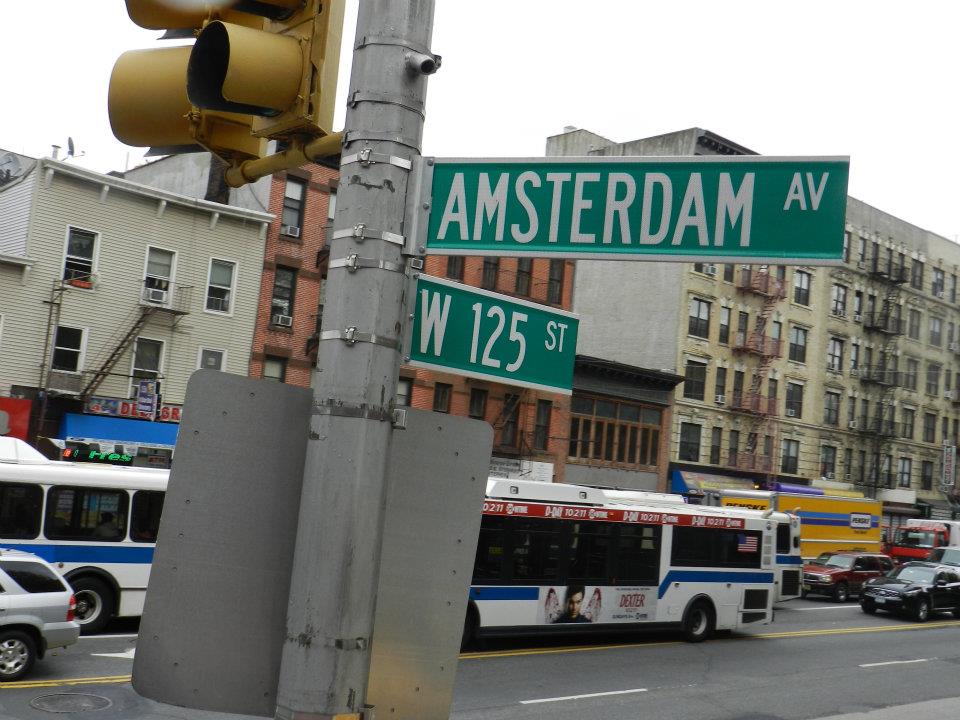
Martin Luther King, Jr. Blvd.: For your information, 125th Street is a two-way street that runs east-west in Manhattan, and it is considered the "Main Street" of Harlem. It is also known as Martin Luther King, Jr. Boulevard.
As of 2011, former president Bill Clinton maintains an office on 125th Street.
 |
| Apollo Theater |
Apollo Theater: The Apollo Theater is one of the oldest and most famous music halls in the United States, and the most famous club associated almost exclusively with African-American performers.
It is located at 253 W. 125th Street in Manhattan, specifically in Harlem, one of the United States' most historically significant traditionally African-American neighborhoods.
Through the Years: The Apollo Hall, as it was known in the early years, was founded in the mid-19th century by a former Civil War General as a dance hall and ballroom. At the end of his lease in 1872, it was converted to a theater, which closed shortly before the turn of the 19th to 20th century. The name "Apollo Theater" lived after being purchased again in 1913-1914 when it was opened as a burlesque theater. It remained in operation as such until 1928, when it was repurchased and reopened many times later through out the years. Following the World War I era the Harlem Renaissance was occurring at the time and there was a Great Migration of blacks from the southern states, and in the mid-1930's it was opened with "a colored review" with all proceeds donated to the Harlem Children's Fresh Air Fund. The owner at the time, Schiffman's motivation for featuring Negro talent and entertainment was not only because the neighborhood had become Negro over a long period of gradual migration, but because colored entertainers were cheaper to hire, and Schiffman could offer quality shows for reasonable rates. There are precisely 1,506 seats in the Apollo Theater. For many years, Apollo was the only theater in New York City to hire black people.
Notable Appearances: In November of 1934, the late Ella Fitzgerald made her singing debut at age 17 at the Apollo. It also became famous for launching the careers of artists such as Fitzgerald, Billie Holiday, James Brown, Diana Ross & The Supremes, Gladys Knight & the Pips, The Jackson 5, Patti LaBelle, Marvin Gaye, Luther Vandross, Stevie Wonder, Aretha Franklin, Ben E. King, Mariah Carey, The Isley Brothers, Lauryn Hill, Sarah Vaughan. Jimi Hendrix won the first place prize in an amateur musician contest at the Apollo in 1964. During an appearance at the Apollo in January 2012, President Barack Obama sang the opening line of Al Green's "Let's Stay Together." It was also recently announced that Bruce Springsteen and the E Street Band will be playing the Apollo on March 9, 2012 in a private concert for Sirius XM.
 |
| United House of Prayer for All People in Harlem |
The United House of Prayer for All People in Harlem: The United House of Prayer for All People (also known as United House of Prayer for All People of the Church on the Rock of the Apostolic Faith) (now that is a mouthfull!) is a Christian denomination founded in 1919.
According to church literature and their official website, the United House of Prayer for All People has 131 places of worship in 26 states. The church has an estimated membership of 1.5 million. The church is known for its periodic mass baptisms by fire hose which started around the 1920s by the founder and also for its shout bands.
 |
| Statue in Harlem |
Statue at Right: I am sorry to say that I cannot remember who the statue at right of the woman and child is. Nika recalls that it was dedicated to a woman who was a matriarch in New York for taking in or starting up a safe haven for abused women in relationships and/or for children who were born drug-dependent from drug-abusing mothers. All the research I have done and even calls to the Gray Line Tours to identify this woman have been futile. But for now, even though, I don't have a name to put to her face, she is still considered a hero.
 |
| Malcolm Shabazz Outdoor Market in Harlem |
 |
| Malcolm Shabazz Outdoor Market in Harlem |
Malcolm Shabazz Harlem Market: (See pics at left and below) This colorful market with the mosque-looking structure, located at 52 W. 116th St. in Harlem, is full of fabulous traditional African crafts and textiles which include hair-braiding boutiques, urbanwear, large selection of carved wooden figurines, and handmade African-style clothes for men, women, and children. Occasionally Saturday is a giveaway day. I am told that it is the place to go with little money and that haggling is appropriate. It is open seven days a week, but apparently the amount of vendors selling on Sundays is a bit thinner, since Harlem is a very hugely religious sector, so many are attending services.
Just east of Malcolm X Boulevard, this outdoor soiree specializes in colorful African goods. Vendors hail from countries like Senegal, Nigeria, Kenya and Ghana hawk exotic pieces that are native to their homelands. It is open from 10:00 a.m. to 8:00 p.m., year-round.
 |
| Duke Ellington statue |
 |
| Duke Ellington Sta |
Duke Ellington statue: (See pics to left above and right). A statue of Duke Ellington stands in Duke Ellington Circle, which is a shallow amphitheater at 110th Street and Fifth Avenue in Harlem, at the northeast corner of Central Park.
Description: This monumental piece unveiled in 1997, standing at 25 feet tall, depicts the composer, pianist and bandleader Edward Kennedy ("Duke") Ellington standing beside a concert grand piano, upon a base supported on the heads of nine nude caryatids, who are better known as The Muses. This statue is set within a multi-leveled semi-circular plaza at the gateway to Harlem --the community in which Ellington lived for much of his adult life and with which he is creatively associated.
What are The Muses: The supporting columns of the grand concert piano are nine nude caryatids depicting The Muses. A caryatid is a female-shaped supporting pillar; a column in the shape of a draped female figure supporting a structure such as the porch of a classical Greek temple. In this case, these caryatids represent The Muses which, in Greek mythology, poetry, and literature, are the goddesses who inspire the creation of literature, science and the arts. They were considered the source of the knowledge, retold for centuries in the ancient culture, that was contained in poetic lyrics and myths. They are considered a compliment to a real woman who inspires creative endeavor. Born the nine daughters of Zeus and Mnemosyne, they personify knowledge and the arts, especially literature, dance and music. It was not until Roman times that the following roles were assigned to them: Calliope -epic poetry (centered around a hero); Clio -history; Euterpe -flutes and lyric poetry; Thalia -comedy and narrow-minded poetry; Melpomene -tragedy; Terpsichore -dance; Erato -love poetry; Polyhymnia -sacred poetry; Urania -astronomy.
Significance and Association with Harlem: The sculpture of Duke Ellington is the first monument in New York City dedicated to an African American and the first memorial to Ellington in the United States. A composer, orchestra conductor, and musician, Ellington elevated jazz to the top. The December 1927 opening at the Cotton Club which was the biggest of the Harlem speakeasies is what put the Duke Ellington Orchestra on the jazz map. With Harlem and the Cotton Club as home base, Ellington began radio broadcasts and recorded for American, English, and French labels. Duke was at his most creative era from 1930-1942 , composing such classics as Mood Indigo and Don't Get Around Much Anymore. He also received the Presidential Medal of Freedom in 1969.
 |
| Statue of Dr. Marion Sims |
Dr. J. Marion Sims Statue: Dedicated in 1894, this bronze and granite monument
stands on the perimeter of Central Park in honor of Dr. James Marion Sims. A
renowned surgeon, Sims is regarded as the father of American gynecology. Sims’
work is credited for giving the field
status as a separate medical specialty, which all of us women can be truly thankful for today. He founded a hospital for women
in New York and then become president of the American Medical
Association. Celebrated while alive for his medical contributions, he has
since become a controversial figure for his use of slave women as
experimental subjects.
 |
| Guggenheim (to the right) |
Guggenheim Museum (The picture at right shows the Guggenheim at the far right). Designed by architect Frank Lloyd Wright, the Solomon R. Guggenheim Museum (more popularly known as "The Guggenheim") is a well-known museum located on the Upper East Side of Manhattan. It is admired as much for its architecture as its art and it is one of the 20th century's most important architectural landmarks. The bright white exterior and glass-domed interior give the museum a modern, clean feel. Most noted here is the "Great Rotunda," which has played home to many exhibitions. It now has a ten-story tower; giving the museum extra space and it also contains a sculpture collection and a cafe overlooking Central Park . It is the permanent home to a renowned collection of Impressionist, Post-Impressionist, early Modern, and contemporary art and also features special exhibitions throughout the year. The museum opened on October 21, 1959, and from 2005 to 2008 it underwent an extensive renovations. Recently, it is undergoing, again, more extensive renovations and that is what was happening on the day we went there. Upon entering we found out that most (75%) of the architectural details of the interior of the building and its displays would not be on our tour, so we decided to skip this museum all together.
The Guggenheim has become a cultural icon and can be seen widely throughout popular movies and television shows. It was featured in such greats as Bye Bye Birdie, Men in Black, When in Rome, and Ugly Betty; and prominently in The International, where a major shootout occurs in the museum. In fact, a life-size replica of the museum was built for this scene. The film, Mr. Popper's Penguins has a sequence where the penguins cause a disturbance entering the museum, wander to the top of the gallery structure and slide down the entire spiral structure to the ground floor.
The Guggenheim has become a cultural icon and can be seen widely throughout popular movies and television shows. It was featured in such greats as Bye Bye Birdie, Men in Black, When in Rome, and Ugly Betty; and prominently in The International, where a major shootout occurs in the museum. In fact, a life-size replica of the museum was built for this scene. The film, Mr. Popper's Penguins has a sequence where the penguins cause a disturbance entering the museum, wander to the top of the gallery structure and slide down the entire spiral structure to the ground floor.
 |
| Metropolitan Museum of Art |
 |
| The "Met |
Metropolitan Museum of Art: I am told that any visitor to the "Big Apple" should spend at least a couple of hours at this vast museum. Although it was on our list of “to-see” places, unfortunately we were not able to fit it into our schedule. (See pics to left and below-right).
The Metropolitan Museum of Art (commonly referred to as “The Met”) is a renowned art museum located on the eastern edge of Central Park along Manhattan's Museum Mile (5th Avenue and 82nd Street), and is one of the world's largest art galleries. Its permanent collection contains more than two million works, divided into nineteen departments. The Met measures almost 1/4-mile long and occupies more than 2 million square feet with more than 1.5 million square feet of exhibition space. It was founded in 1870 by a group of American citizens, who included businessmen and financiers, as well as leading artists and thinkers of the day, who wanted to open a museum to bring art and art education to the American people. It opened in February 1872, but was originally located at 681 Fifth Avenue
European paintings on display include works by Monet, Degas, and Van Gogh. The Egyptian gallery is considered unparalleled. It also has many displays of Asian art, sculpture, armory, and photography. During warm weather, the open-air roof garden displays contemporary sculptures. It also contains an extensive collection of American and modern art and maintains extensive holdings of African, Asian, Oceanic, Byzantine, and Islamic art. It also houses collections of musical instruments, costumes and accessories, and antique weapons and armor from around the world.
The Metropolitan Museum of Art (commonly referred to as “The Met”) is a renowned art museum located on the eastern edge of Central Park along Manhattan's Museum Mile (5th Avenue and 82nd Street), and is one of the world's largest art galleries. Its permanent collection contains more than two million works, divided into nineteen departments. The Met measures almost 1/4-mile long and occupies more than 2 million square feet with more than 1.5 million square feet of exhibition space. It was founded in 1870 by a group of American citizens, who included businessmen and financiers, as well as leading artists and thinkers of the day, who wanted to open a museum to bring art and art education to the American people. It opened in February 1872, but was originally located at 681 Fifth Avenue
European paintings on display include works by Monet, Degas, and Van Gogh. The Egyptian gallery is considered unparalleled. It also has many displays of Asian art, sculpture, armory, and photography. During warm weather, the open-air roof garden displays contemporary sculptures. It also contains an extensive collection of American and modern art and maintains extensive holdings of African, Asian, Oceanic, Byzantine, and Islamic art. It also houses collections of musical instruments, costumes and accessories, and antique weapons and armor from around the world.
 |
| The "Tornado" Statue |
"Tornado" Statue: This statue was located at
the south part of Central Park just across the street from the Plaza
Hotel. The Tornado was a new commission that rose to more than 30 feet in height, but if you hadn't seen it in person before, you will not see it there again as it was only on display in Central Park until
February 19, 2012. It visualizes a densely packed storm system, rising to more than 25 feet and
features some approximately 100 distinct "clouds" made of inflated truck inner
tube tires securely individually to a steel structure. Inspired by high velocity winds and the raw power associated with the weather phenomena of tornadoes, it rustles in the wind creating a
dynamic, kinetic sculpture.
Central Park Carriage Rides: Horse-Drawn Carriages are a unique and wonderful way to experience the beauty of Central Park. These horse and buggies can be found all year round lined up along Central Park South between 5th and 6th Avenues.
 |
| Horse-Drawn Carriages Lined Up by Central Park |
In New York City, horses are a symbol of a bygone era before the convergence of cars, buses and trains. It was during this time that New Yorkers got around from place to place on horseback or by means of horse-drawn carriage. As a result and over time, horses became iconic to the history of Manhattan. New York City law restricts that no carriage may operate above 89 degrees or below 19 degrees or during Blizzards. Ride lengths range from 30 minutes to 3 hours.
One of the items on our (my) itineary for Friday night was for the three of us to take a horse-drawn carriage ride through Central Park to experience its virtues. But the weather that night was nasty, rainy and a little chilly, plus with all our bags (okay, my bags) it would have been a little cumbersome. Another item to put on my to-do list on my next visit to NYC!
One of the items on our (my) itineary for Friday night was for the three of us to take a horse-drawn carriage ride through Central Park to experience its virtues. But the weather that night was nasty, rainy and a little chilly, plus with all our bags (okay, my bags) it would have been a little cumbersome. Another item to put on my to-do list on my next visit to NYC!
 |
| Jose Julian Marti Monument |
Jose Julian Marti Monument: Martí , a
Cuban patriot, journalist and poet, fought for the liberation of Cuba
from Spanish rule and was an important figure in Latin American literature. The statue shows the moment when Martí was mortally
wounded in battle.
In his short life of 42 years, José Julián Martí Pérez laid claim to being a poet, essayist, journalist, revolutionary philosopher, translator, professor, publisher, and a political theorist. Through his many writings and political activity, he became a symbol for Cuba's bid for independence against Spain and is often referred to as the "Apostle of Cuban Independence." Also fighting against the threat of United States expansionism into Cuba, he dedicated his life to the promotion of political independence for Cuba and independence for all Spanish Americans. His death was decreed as a cry for Cuban independence from Spain. Considered a liberal, he fought for the idea that it was unnatural for Cuba to oppressed and controlled by Spain.
Martí campaigned for the liberation of Cuba from Spain and was imprisoned by Spanish authorities in 1868. Fleeing to New York in 1880, he continued to advocate for Cuban freedom while in exile and organized the Cuban Revolutionary Party in 1892. Martí returned to Cuba in 1895, at the beginning of Cuba’s successful fight for independence. The monument depicts a reeling Martí after being fatally wounded while atop his horse during the 1895 battle at Dos Rios. Although the statue was completed in 1959, the political climate between pro- and anti-Castro elements in New York necessitated the delay of the monument’s unveiling until 1965.
Created by sculptor Anna Hyatt Huntington, this was her last major work, at the age of 82, and it was presented as a gift to the Cuban government for presentation to the people of New York City.
The piece is one of a trio of bronze equestrian sculptures representing Latin-American leaders that greet visitors to Central Park at the north end of Avenue of the Americas, which was named in 1945 at the suggestion of Mayor Fiorello H. LaGuardia to honor Pan-American ideals and principles. Following the renaming of Sixth Avenue, a new plaza was designed where the avenue meets Central Park, and the monument of Simon Bolivar (mentioned in my previous posts) was moved to the eastern side of the plaza and rededicated. A month later the statue of Argentine general José de San Martín (below) was unveiled on the west side of the plaza, and in 1965, the Marti monument was dedicated between the two earlier monuments.
 |
| José de San Martín Statue in Central Park |
 |
| "You Dirty Rat!" |
Oh, oh, it is the Giant Inflatable Rat! Someone hasn't been nice! A ''rat contractor'' is an old
phrase in construction and can refer to an employer who is not
providing proper safety equipment, benefits or wages. When the union (in
this case, Construction and General
Building Laborers Local 79) gets a complaint, if the job site isn't one
the union is already monitoring, the union research department checks it
with the reports all contractors are required to file with the city.
And onto the job site goes the Big Rat. The actual decision to send out one of the gray, red-eyed, snarling rats
is usually made by Local 79's market development department. Since I work for a labor and employment (employee rights) law firm, all I can say is, best be
nice, you dirty rat!

Playwright Tavern: The Playwright Tavern, located in the heart of the Times Square in the exciting Theater District, at 202 West 49th Street, offers up delicious Irish-American
cuisine. Serving New York since 1995, this three level Irish restaurant
and bar is a regular stop off for theater goers
before and after a Broadway or Radio City Music Hall show. It is also conveniently located just minutes from Rockefeller Centre and St.
Patrick's Cathedral.
Times Square: As we are getting back to Times Square on
the end of this loop for today, I'm taking pictures of many of the
fabulous sights there. There is so many sights to see that it seemed as
though my camera crawled out of its case, lept out of my hand and
started clicking away. So I need to share some of these with you.
+ |
| M&M's World |
 |
| M&M's Electronic Billboard |
M&M's World: What is a trapse through Times Square without snapping a picture or two of the sign and billboards at M&M's World Store. M&M's World is a retail store that specializes in everything from M&M's candy to M&M's clothing. Opening in 2006, the New York City location within a 24,000-square-foot, three-level glass box. It includes a 50-foot-wide, two-story-high, "wall of chocolate", made up of 72 continuous candy-filled tubes.
M&M's World in Times Square is New York City's largest candy
store, and offers merchandise such as themed clothing, dishware,
watches, and piggy banks. Before it opened in 2006, nearly 13,000 people
lined up for the 198 jobs, which were in demand because of a more
generous health benefit package than is usually offered for an
entry-level retail job in New York. A tidbit of interest: In June 2011, M&M's World Store in London opened to the public and it has now been dubbed the world's largest candy store, at 35,000 sq. ft.
 |
| M&M's Electronic Billboard |
 |
| Madame Tussauds at street level |
 |
| The Upper Hand at Madame Tussauds |
So enchanting and cool, isn't it! I'm fascinatingly infactuated!
 |
| Full View of Madame Tussauds |
 |
| Lower Hand at Madame Tussauds |
 |
| Chevy's Mexican Restaurant |
 |
| Villa Pizza Man |

More, More, More: We are passing by a couple restaurants whose signage in front magnetize me. I won't try to clutter today's post up with much more clicks here and there. But don't you agree that the "Chevy's" sign and the "Villa Pizza Man" catch your attention, too!
New Amsterdam Theater: the famous New Amsterdam
Theater. Built in 1903, at the time of construction, it was the largest theatre in New York with a seating capacity of 1,702. Along with one other theater, which was also built in 1903,
the New Amsterdam is the oldest surviving Broadway venue still in use today. It was
currently presenting the musical Mary Poppins.
For many years, it hosted the famous Ziegfeld Follies. The Great Depression took its toll on the theatre business, and in 1936 the New Amsterdam closed, but reopening on a limited basis in 1937 and was soon converted to a movie theatre. It was purchased in 1982 but would not be completely rehabilitated until eight years later when in 1990, after a court battle, the State and City of New York assumed ownership of the New Amsterdam and many other theatres on 42nd Street. Disney Theatrical Productions signed a 99 year lease for the property in 1993. The theatre, which had recently been used as a filming location for the movie Vanya on 42nd Street, was in shambles; it would take several years and millions of dollars, to restore it to its original usage and grandeur. It was officially reopened in April 1997. In November 1997, after the premiere of the film Hercules and a limited engagement of a concert version of King David, Disney's stage version of The Lion King opened. In June 2006, The Lion King closed in The New Amsterdam Theatre and in November 2006, Mary Poppins opened.
For many years, it hosted the famous Ziegfeld Follies. The Great Depression took its toll on the theatre business, and in 1936 the New Amsterdam closed, but reopening on a limited basis in 1937 and was soon converted to a movie theatre. It was purchased in 1982 but would not be completely rehabilitated until eight years later when in 1990, after a court battle, the State and City of New York assumed ownership of the New Amsterdam and many other theatres on 42nd Street. Disney Theatrical Productions signed a 99 year lease for the property in 1993. The theatre, which had recently been used as a filming location for the movie Vanya on 42nd Street, was in shambles; it would take several years and millions of dollars, to restore it to its original usage and grandeur. It was officially reopened in April 1997. In November 1997, after the premiere of the film Hercules and a limited engagement of a concert version of King David, Disney's stage version of The Lion King opened. In June 2006, The Lion King closed in The New Amsterdam Theatre and in November 2006, Mary Poppins opened.
 |
| Nika Shopping in Forever 21, Times Square |
Nika Shopping: We are now done with today's
bus tour and Nika still needs to find a dress for tonight's Wicked.
Since it was still misty out, like drowned little mice, we left our rain
ponchos on and headed into Forever 21 to peer around some more. Not working far from this store, Casey eventually caught up with us and helped Nika find a fascinating dress for our big evening out.
So off to the hotel we go. Onward to get spiffed up and put our glamour on. My stomach is doing cartwheels at the thought of seeing my first Broadway play.
Now, I will sign off because I have to get dressed. The next post you will read will be all about Wicked. I can hardly wait!
So off to the hotel we go. Onward to get spiffed up and put our glamour on. My stomach is doing cartwheels at the thought of seeing my first Broadway play.
Now, I will sign off because I have to get dressed. The next post you will read will be all about Wicked. I can hardly wait!


